
Key Takeaways:
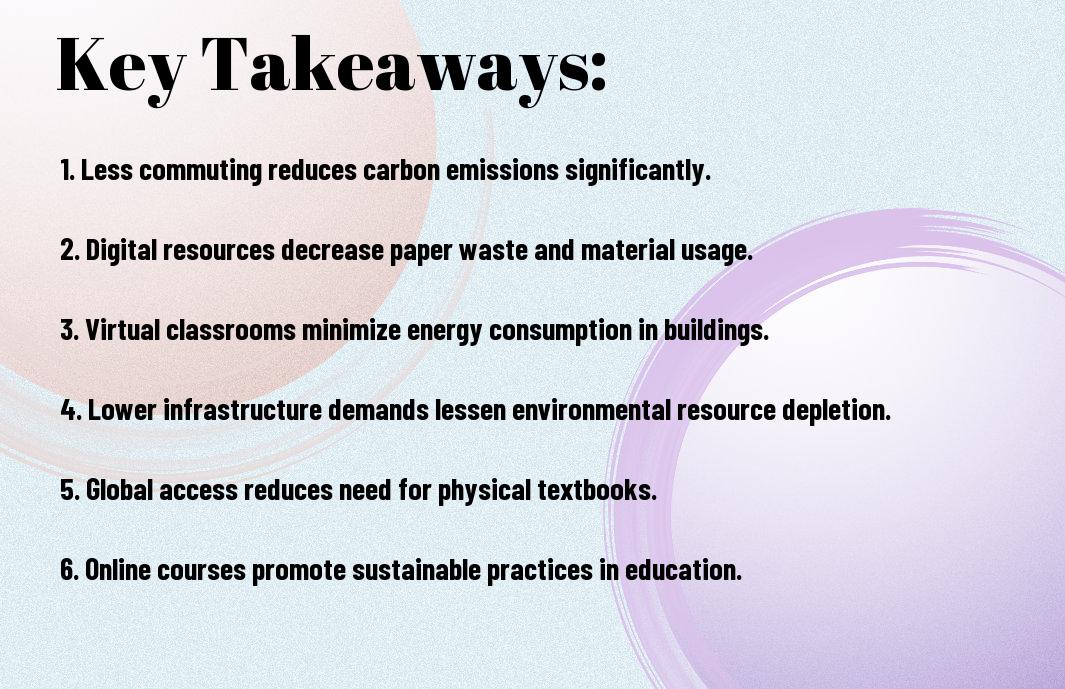
- Online education helps in reducing the carbon footprint by minimizing the need for transportation to and from educational institutions, resulting in lower greenhouse gas emissions.
- The shift to online learning reduces the demand for physical infrastructure, such as buildings and classrooms, which in turn reduces the need for energy consumption and water usage.
- Online education promotes the use of digital resources, reducing the need for printed materials and minimizing waste generation.
- By reducing the need for commuting, online education helps decrease air pollution and contributes to a cleaner and healthier environment.
- Overall, online education offers a more sustainable approach to learning, allowing students to access quality education while minimizing their ecological impact.
Environmental Consequences of Traditional Education
The traditional education system has a significant impact on the environment, and as you investigate into the details, you’ll find that it’s affecting the planet in various ways. You can learn more about the Impact of E-learning on the environment and its benefits and how it compares to traditional methods.
Carbon Footprint of Physical Infrastructures
Between the construction of buildings, energy consumption, and transportation, traditional education institutions have a substantial carbon footprint, and as you consider the alternatives, you’ll see that online education offers a more sustainable solution.
Waste Management in Educational Institutions
An overlooked aspect of traditional education is waste management, and as you explore this topic, you’ll discover that educational institutions generate a significant amount of waste, from paper and plastic to food and electronics, which can have a lasting impact on the environment.
Indeed, as you investigate further, you’ll find that the waste generated by traditional educational institutions is not only harmful to the environment, but it also reflects a lack of consideration for the planet’s well-being, and by choosing online education, you can significantly reduce your contribution to this problem, creating a more sustainable future for yourself and future generations.
Digital Learning and Its Benefits
One of the most significant advantages of online education is the flexibility and accessibility it offers you, allowing you to learn from anywhere, at any time, and at your own pace, thus making it an attractive option for those seeking to expand their knowledge and skills.
Reduced Paper Consumption and E-Waste
Similarly, one of the key benefits of digital learning is the significant reduction in paper consumption and e-waste, which not only helps minimize your environmental footprint but also reduces the costs associated with traditional learning materials, making education more sustainable and affordable for you.
Virtual Classrooms and Energy Efficiency
Around the world, you are witnessing a shift towards virtual classrooms, which are not only more energy-efficient but also provide you with a unique opportunity to engage with a global community of learners, fostering a more collaborative and dynamic learning environment that is tailored to your needs and preferences.
Indeed, as you examine deeper into the world of virtual classrooms, you will discover that they offer a multitude of benefits, from reducing the need for physical infrastructure and energy consumption to providing you with access to a vast array of educational resources and tools, thereby enhancing your overall learning experience and empowering you to take control of your educational journey.
Online Education and Resource Conservation
Keep in mind that online education plays a significant role in reducing your environmental footprint. By transitioning to digital platforms, you contribute to a more sustainable future, conserving resources and minimizing waste.
Access to Digital Resources and Reduced Textbook Waste
About the benefits of online education, you’ll find that accessing digital resources significantly reduces textbook waste, allowing you to learn without the guilt of contributing to deforestation and pollution.
Cloud Computing and Data Storage
Any doubts you may have about the environmental impact of online education should be alleviated by the fact that cloud computing and data storage enable you to access vast amounts of information without the need for physical infrastructure, reducing your carbon footprint.
This facet of online education is particularly noteworthy, as it enables you to store and access vast amounts of data without the need for physical servers, thereby reducing energy consumption and minimizing electronic waste, allowing you to focus on your studies while contributing to a more sustainable world.
Impact on Student Transportation and Commuting
All aspects of your daily commute are significantly altered when you switch to online education, as the need to travel to a physical campus is eliminated, thereby reducing your carbon footprint.
Reduced Fuel Consumption and Air Pollution
Altogether, the decrease in fuel consumption has a profound impact on air pollution, as you are no longer contributing to the emissions from vehicles, thus creating a cleaner environment for yourself and your community.
Increased Accessibility for Remote Students
The notion that online education can reach you regardless of your geographical location is a significant advantage, as you can now access educational resources and opportunities that were previously inaccessible due to distance or mobility constraints.
Considering the vast array of online educational platforms and tools available, you can now participate in courses and degree programs that cater to your interests and career goals, without having to relocation or compromise on your personal circumstances, ultimately enhancing your overall learning experience and potential for personal growth.
Innovative Technologies for Sustainable Education
After embracing online education, you can explore various innovative technologies that promote sustainability. You will discover new ways to reduce your environmental footprint while accessing quality education.
Virtual Reality and Immersive Learning Experiences
Sensibly, you can utilize virtual reality to create immersive learning experiences that mimic real-world environments, reducing the need for physical infrastructure and travel.
Artificial Intelligence and Personalized Learning
On the path to sustainable education, you will encounter artificial intelligence as a key player in personalized learning. You can leverage AI to tailor your educational experience, making it more efficient and effective.
Understanding how artificial intelligence works in personalized learning, you can appreciate the potential to minimize waste and optimize resource allocation. As you investigate deeper, you will find that AI-driven adaptive learning systems can help you learn at your own pace, reducing the need for repeated lessons and minimizing energy consumption.
Challenges and Limitations of Online Education
For your consideration, as you probe into online education, you will encounter challenges that hinder its potential to reduce environmental impact. You can explore Practical Strategies to Reduce Environmental Impact to understand the complexities involved.
Digital Divide and Accessibility Issues
Apart from the obvious benefits, you will notice that online education also raises concerns about accessibility, as not all individuals have equal access to digital resources, thereby limiting your reach and effectiveness.
Technical Challenges and Infrastructure Limitations
Beneath the surface of online education lies a array of technical challenges, including poor internet connectivity and outdated hardware, which can hinder your ability to fully engage with online courses and materials.
Technical infrastructure plays a significant role in determining the success of online education, and as you navigate this landscape, you will need to consider factors such as bandwidth, server capacity, and software compatibility to ensure seamless delivery of educational content, thereby enhancing your overall learning experience.
To wrap up
Drawing together the threads of this discussion, you can see that online education plays a significant role in minimizing your ecological footprint. As you explore the benefits of virtual learning, you may want to explore into the Pros and cons of online education as a measure to reduce carbon emissions, and discover how your choices can contribute to a more sustainable future, shaping your approach to education and the environment.
FAQ
Q: How does online education reduce carbon footprint?
A: Online education significantly reduces carbon footprint by minimizing the need for commuting to educational institutions. With online learning, students can access courses and educational resources from anywhere, eliminating the need for transportation, which is a major contributor to greenhouse gas emissions. Additionally, online education reduces the demand for physical infrastructure, such as classrooms and buildings, which also helps to decrease carbon emissions. By reducing the carbon footprint, online education plays a significant role in mitigating climate change and promoting sustainability.
Q: What role does digitalization play in reducing waste in online education?
A: Digitalization plays a significant role in reducing waste in online education by minimizing the need for physical materials such as textbooks, paper, and other printed resources. Online educational platforms provide digital access to course materials, readings, and assignments, which reduces the amount of waste generated by traditional educational methods. Furthermore, digitalization enables the reuse and sharing of resources, reducing the demand for new materials and minimizing electronic waste. By adopting digitalization, online education contributes to a more sustainable and environmentally-friendly learning environment.
Q: How does online education promote sustainable resource utilization?
A: Online education promotes sustainable resource utilization by optimizing the use of resources such as energy, water, and land. With online learning, educational institutions can reduce their energy consumption by minimizing the need for lighting, heating, and cooling physical classrooms. Additionally, online education reduces the demand for water and land, as there is no need for physical infrastructure. Online education also promotes the use of renewable energy sources and encourages the adoption of sustainable practices, such as reducing paper usage and minimizing electronic waste. By promoting sustainable resource utilization, online education contributes to a more environmentally conscious and responsible learning environment.