
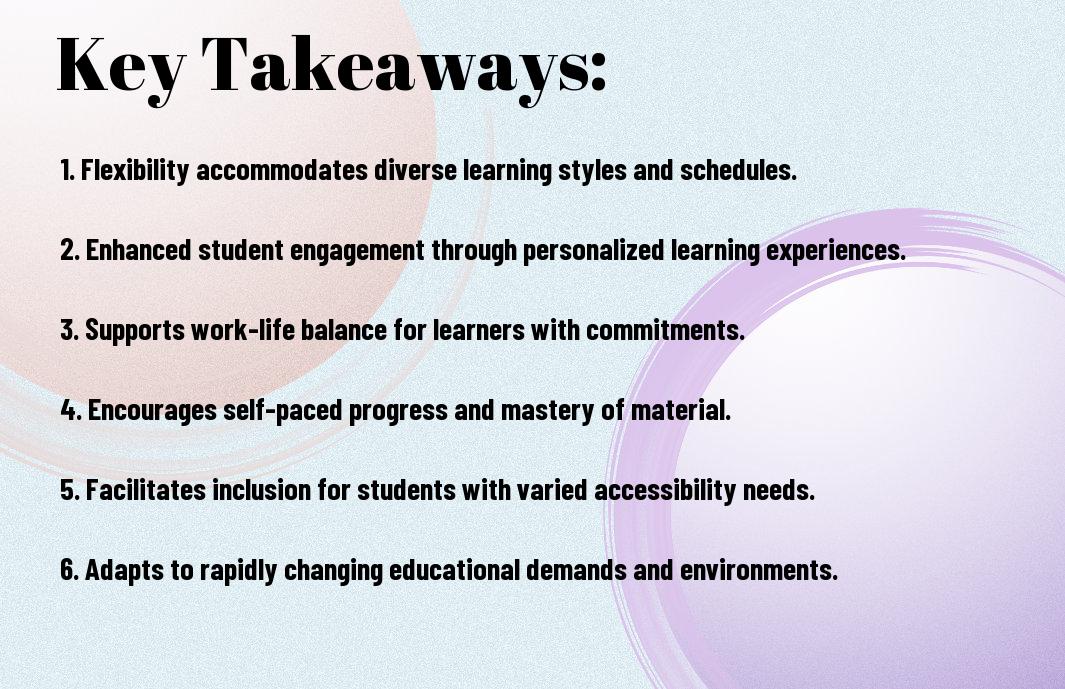
Key Takeaways:
To succeed in online education, it’s vital to understand the role of flexibility. Here are key points to consider:
- Adaptability is imperative for learners to manage their time effectively and balance their academic responsibilities with other obligations, allowing them to thrive in online learning environments.
- Online courses that offer self-paced learning experiences enable students to complete assignments and learn at their own speed, which can lead to better retention of information and improved academic outcomes.
- Accessibility features, such as closed captions and transcripts, are vital for ensuring that all students can access and engage with online course materials, regardless of their abilities or technological constraints.
- Incorporating varied teaching methods and multimedia resources can help to keep students engaged and motivated, as they can interact with the material in ways that suit their individual learning styles.
- Support services, such as virtual office hours and online tutoring, provide students with the resources they need to succeed in online courses, helping to foster a sense of community and connection among learners.
The Need for Adaptability
To succeed in online education, you need to understand the difference between traditional and online learning environments. You can learn more about Classroom Learning vs. Online Learning and how it affects your educational experience.
Evolving Student Needs
About the changing landscape of education, you should consider how your needs are evolving as a student. Your schedule, learning style, and goals all play a role in determining the type of educational experience you require.
Technological Advancements
Across various platforms and devices, you have access to a wide range of educational tools and resources. Your ability to adapt to new technologies is imperative for success in online education.
Another significant aspect of technological advancements is the ability to access educational content anywhere, at any time. You can use your mobile device or computer to engage with course materials, participate in discussions, and collaborate with peers, making it easier to balance your education with other aspects of your life. As you navigate the online learning environment, you will find that technological advancements provide you with the flexibility and convenience you need to achieve your educational goals.
Enhancing Learning Experience
Some of the key benefits of flexibility in online education include the ability to learn at your own pace and on your own schedule, allowing you to balance your educational goals with your personal and professional responsibilities. This flexibility also enables you to take ownership of your learning experience, tailoring it to your individual needs and interests.
Personalized Learning Paths
Any attempt to create a one-size-fits-all approach to online education is likely to fall short, as you have unique learning style and preferences. By offering personalized learning paths, online education providers can help you stay engaged and motivated, increasing the likelihood of achieving your academic goals.
Real-time Feedback Mechanisms
An effective online education platform should provide you with real-time feedback mechanisms, enabling you to track your progress and identify areas where you need improvement. This allows you to adjust your approach and make data-driven decisions about your learning.
In addition, real-time feedback mechanisms can help you stay on track and motivated, as you can see the direct impact of your efforts on your learning outcomes. You can use this feedback to reflect on your learning, identifying what works best for you and making adjustments to optimize your educational experience.
Overcoming Obstacles
Your ability to adapt to online education is key to success, and flexibility plays a significant role in this process, enabling you to navigate through challenges and achieve your goals.
Accessibility Barriers
To tackle the issues that hinder your progress, you must first identify the obstacles, such as inadequate technology or poor internet connectivity, and find ways to overcome them to ensure a smooth learning experience.
Digital Literacy Gaps
Any lack of familiarity with digital tools can hinder your ability to fully engage with online courses, making it imperative to develop the necessary skills to effectively utilize these platforms and access the resources you need.
Further developing your digital literacy will enable you to better navigate online learning platforms, access a wide range of educational resources, and engage with your instructors and peers more effectively, ultimately enhancing your overall learning experience and helping you to achieve your academic goals.
Innovative Strategies
All educators can benefit from implementing innovative strategies in online education, which can enhance your students’ learning experience and increase their engagement.
Gamification Techniques
Along with interactive elements, gamification techniques can make your online courses more enjoyable and motivating for your students, allowing you to track their progress and adjust your teaching methods accordingly.
Collaborative Learning Tools
After implementing collaborative learning tools, you will notice an improvement in your students’ teamwork and communication skills, as they work together to achieve common goals and share knowledge with each other.
The collaborative learning tools you choose will depend on your specific needs and the nature of your online course, but you can consider options such as discussion forums, virtual groups, and peer review platforms, which will enable your students to interact with each other and with you, fostering a sense of community and promoting deeper learning.
Embracing Change
Unlike traditional educational settings, online education requires you to be adaptable and flexible in your approach, allowing you to navigate through new technologies and methodologies with ease, making your learning experience more efficient and effective.
Teacher Training Programs
Tutors need to undergo training programs that equip them with the skills to handle online classes, enabling you to get the most out of your online education, with instructors who are well-versed in the digital learning environment.
Curriculum Development
One of the key aspects of online education is the development of a curriculum that caters to your needs, providing you with a personalized learning experience that is both engaging and informative, helping you to achieve your academic goals.
With a well-structured curriculum in place, you can expect to see significant improvements in your learning outcomes, as you are able to focus on the areas that interest you the most, and research deeper into the subjects that you are passionate about, allowing you to gain a more comprehensive understanding of the material, and apply it in a practical and meaningful way.
Effective Implementation
Keep in mind that flexibility in online education is key to its success, and you need to consider various factors to implement it effectively in your educational setting.
Resource Allocation
Respecting your budget and available resources, you should allocate them thoughtfully to ensure that your online courses are well-supported and functional, allowing you to provide a high-quality learning experience for your students.
Student Engagement Strategies
Around the clock, you can use various tools and techniques to engage your students, such as discussion forums, live chats, and interactive multimedia content, to keep them motivated and interested in the course material.
In fact, as you explore different student engagement strategies, you will find that incorporating elements of gamification, peer-to-peer learning, and real-world applications can help you create a more immersive and effective learning environment, allowing your students to stay engaged and achieve their academic goals more efficiently.
Summing up
Conclusively, you will find that flexibility in online education allows you to balance your schedule and workload more effectively. As you navigate your online courses, you will appreciate the ability to access your materials and submit assignments at your own pace. Your learning experience will be enhanced, and you will be more likely to succeed in your academic pursuits. By leveraging flexibility, you can tailor your education to fit your unique needs and goals.
FAQ
Q: What role does flexibility play in enhancing the overall learning experience in online education?
A: Flexibility is crucial in online education as it allows students to balance their academic responsibilities with other aspects of their lives, such as work and family obligations. With the ability to access course materials and participate in classes at any time, students can create a schedule that suits their needs, leading to a more effective and enjoyable learning experience. This flexibility also enables students to learn at their own pace, speeding up or slowing down as necessary, which can significantly improve knowledge retention and understanding.
Q: How does flexibility in online education accommodate different learning styles and preferences?
A: The flexibility inherent in online education platforms caters to a wide range of learning styles and preferences. For instance, students who are visual learners can focus on video lectures and interactive modules, while those who are auditory learners can benefit from podcasts and audio recordings. Additionally, the flexibility to review material as many times as needed accommodates students who may need to revisit concepts multiple times before grasping them. This personalized approach to learning enhances engagement and outcomes, as students are able to learn in the manner that best suits them.
Q: Can flexibility in online education contribute to increased student motivation and satisfaction?
A: Yes, flexibility in online education can significantly contribute to increased student motivation and satisfaction. When students have the autonomy to manage their time and learning environment, they are more likely to feel in control of their educational journey. This sense of autonomy, combined with the ability to learn at their own pace and in their preferred style, can boost motivation by making the learning process more enjoyable and rewarding. Furthermore, the flexibility to easily access and interact with course materials can lead to higher levels of satisfaction, as students feel that their educational needs are being met in a way that is both effective and convenient.


