Online Learning

How to Develop Soft Skills Through Online Learning

As you navigate the ever-changing landscape of your career, you’re likely aware that technical skills can only take you so far. Your ability to communicate, collaborate, and adapt will ultimately set you apart. You can develop these soft skills from the comfort of your own space, thanks to the vast offerings of online learning. With a willingness to learn and a reliable internet connection, you can unlock your full potential and cultivate the skills that will serve you well in all aspects of your life, opening doors to new opportunities and experiences.

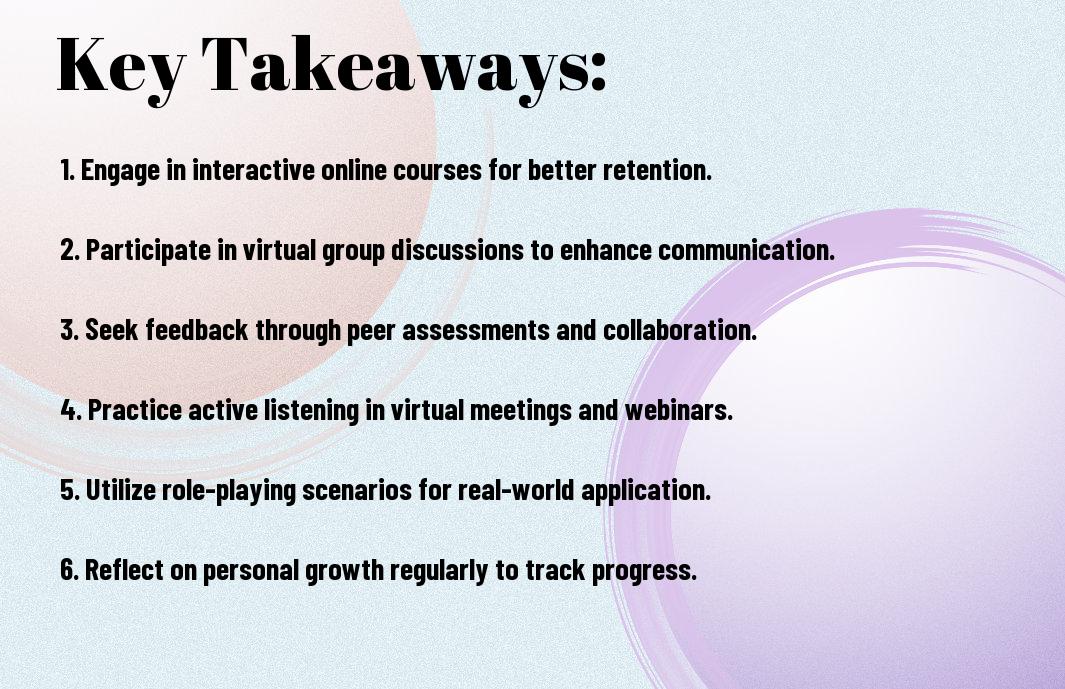
Key Takeaways:

To develop soft skills through online learning, consider the following points:

  • Develop a growth mindset to effectively adapt to new learning environments and approaches, which is vital for successful online learning.
  • Utilize online courses and training programs that focus on communication skills, teamwork, and time management to improve your overall soft skills.
  • Engage in virtual discussions and online communities to practice collaboration and problem-solving skills, which are highly valued in the workplace.
  • Leverage video tutorials and interactive modules to learn adaptability and flexibility skills, which are vital for navigating the ever-changing work environment.
  • Apply self-assessment and feedback mechanisms to evaluate your progress and identify areas for improvement, ensuring continuous skill development and growth.

Benefits of Online Learning

Your journey to developing soft skills through online learning is filled with numerous advantages, and it’s imperative to explore them to make the most of your experience.

Flexibility and Accessibility

One of the significant benefits of online learning is the flexibility it offers, allowing you to access courses and materials from anywhere, at any time, making it easier for you to balance your learning with other aspects of your life.

Personalized Learning Experience

On the path to mastering soft skills, you’ll find that online learning provides a tailored experience, enabling you to learn at your own pace and focus on areas that need improvement, thus enhancing your overall learning experience.

Further, as you explore into the world of online learning, you’ll discover that personalized learning experiences are highly effective in helping you achieve your goals, allowing you to track your progress, set realistic targets, and make adjustments as needed, ensuring that your learning journey is both enjoyable and productive.
Effective Online Platforms

Even as you initiate on your online learning journey, you’ll find numerous platforms to develop your soft skills. Check out Soft Skills Matter – Here’s Eight Ways to Cultivate Them with E-Learning for valuable insights.

MOOCs and Online Courses

About the variety of online courses available, you can explore platforms like Coursera, Udemy, and edX to find the perfect fit for your needs.

Virtual Mentorship Programs

Online mentorship programs offer a unique opportunity for you to connect with experienced professionals and gain valuable guidance.

Plus, as you participate in virtual mentorship programs, you’ll be able to receive personalized feedback, develop your networking skills, and gain confidence in your abilities, all of which will help you grow both personally and professionally, and you’ll be able to apply your new skills in real-world situations, which is a key aspect of effective learning.

Key Soft Skills to Develop

To develop as a well-rounded individual, you’ll want to focus on acquiring a range of soft skills that will serve you well in both personal and professional settings. You can learn these skills through online courses, tutorials, and workshops, and apply them in your daily life.

Communication and Teamwork

After identifying your strengths and weaknesses, you’ll find that effective communication and teamwork are necessary skills to master. You’ll learn how to articulate your thoughts, listen actively, and collaborate with others to achieve common goals, making you a valuable asset to any team.

Time Management and Adaptability

At the heart of success lies the ability to manage your time and adapt to changing situations. You’ll discover how to prioritize tasks, set realistic goals, and adjust to new challenges, allowing you to stay focused and motivated.

Even as you develop your time management and adaptability skills, you’ll find that you’re better equipped to handle unexpected setbacks and capitalize on new opportunities. You’ll learn to prioritize self-care, minimize distractions, and cultivate a growth mindset, enabling you to navigate complex situations with ease and confidence, and make the most of your online learning experience.

Strategies for Successful Online Learning

Unlike traditional learning, online learning requires you to be more self-directed and disciplined. You’ll need to create a schedule and stick to it, setting aside dedicated time for learning and avoiding distractions.

Setting Goals and Staying Motivated

Besides having a clear plan, you’ll also need to define your goals and track your progress, celebrating your successes along the way to stay motivated and focused on your objectives.

Engaging with Online Communities

Between forums, social media groups, and online discussions, you’ll find numerous opportunities to connect with fellow learners, share your thoughts, and learn from others, which can be a valuable supplement to your online learning experience.

And as you engage with online communities, you’ll discover that the interactions can be a powerful way to deepen your understanding of the subject matter, get feedback on your work, and gain new insights from people with different backgrounds and perspectives, ultimately enhancing your overall learning experience and helping you develop your soft skills more effectively.

Overcoming Challenges and Staying Focused

Now that you’ve initiateed on your online learning journey, it’s important to stay focused. You can learn more about effective soft skills training by visiting how to conduct soft skills training for your employees to gain valuable insights.

Managing Distractions and Procrastination

Postponing tasks can hinder your progress. You’ll need to develop strategies to minimize distractions and stay on track, ensuring you make the most of your online learning experience.

Seeking Support and Feedback

Before you begin, consider seeking guidance from mentors or peers who can offer valuable feedback and support, helping you navigate the challenges of online learning.

Overcoming obstacles requires perseverance and the right mindset. As you seek support and feedback, you’ll become more self-aware, allowing you to adjust your approach and make steady progress in developing your soft skills through online learning, and ultimately, achieving your goals.

Measuring Progress and Achievement

After dedicating time to developing your soft skills through online learning, you’ll want to assess your progress. You can find valuable insights on what are soft skills and how to develop them with e-learning to help you evaluate your growth.

Tracking Skills Development

About the methods you use to track your skills development, you’ll find that setting milestones and reflecting on your experiences helps you stay focused on your goals.

Celebrating Successes and Identifying Areas for Improvement

Above all, acknowledging your achievements and pinpointing areas that need more attention will help you refine your approach to learning.

Due to the importance of self-assessment in the learning process, you’ll want to regularly take stock of your progress, celebrating the skills you’ve mastered and identifying areas where you need more practice or guidance, allowing you to adjust your strategy and continue growing.

Conclusion

Now that you’ve launched on this journey to develop your soft skills through online learning, you’ll find that your abilities will blossom in unexpected ways. As you continue to nurture your growth, you’ll discover that your confidence and creativity will flourish, allowing you to tackle new challenges with ease. With persistence and dedication, you’ll unlock your full potential, and your online learning experience will become a transformative adventure that shapes your future.

FAQ

Q: What are the benefits of developing soft skills through online learning?

A: Developing soft skills through online learning provides numerous benefits, including flexibility, accessibility, and self-paced learning. Online courses and tutorials allow individuals to learn and develop skills such as communication, teamwork, and time management at their own convenience, without being constrained by geographical location or rigid schedules. Additionally, online learning platforms often offer a wide range of courses and resources, enabling learners to explore various aspects of soft skills development and choose topics that align with their interests and career goals.

Q: How can I effectively engage with online courses and resources to develop my soft skills?

A: To effectively engage with online courses and resources for soft skills development, it is necessary to set clear goals and objectives, create a dedicated learning schedule, and establish a conducive learning environment. Learners should also actively participate in discussions, complete assignments and quizzes, and seek feedback from instructors or peers. Furthermore, utilizing video conferencing tools, online forums, and social media groups can facilitate interaction with others, helping to build networks and foster a sense of community. By being proactive and committed, individuals can maximize their learning experience and achieve significant improvements in their soft skills.

Q: What strategies can I use to apply and practice my newly acquired soft skills in real-world situations?

A: To apply and practice newly acquired soft skills in real-world situations, individuals can start by identifying opportunities in their personal and professional lives where these skills can be utilized. This may involve taking on new projects, volunteering for leadership roles, or participating in group activities that require collaboration and communication. Learners can also seek feedback from colleagues, friends, or mentors, and reflect on their experiences to identify areas for improvement. Additionally, setting up a journal or log to track progress, and celebrating small victories and accomplishments, can help reinforce new skills and motivate continued growth and development. By applying these strategies, individuals can effectively translate their online learning into practical, real-world applications.


How do online language learning courses handle the teaching of difficult languages, such as Mandarin or Arabic

Online Learning has revolutionized the way we grasp complex languages like Mandarin or Arabic. When you explore into online language courses designed for challenging languages, you’ll discover innovative methods tailored to your needs. From interactive exercises and cultural immersion to personalized feedback, these platforms prioritize your learning journey. Embrace the virtual classroom, where mastering elusive languages becomes an achievable goal with the right guidance at your fingertips.

Key Takeaways:

  • Use of interactive exercises: Online language learning courses for difficult languages incorporate interactive exercises to engage learners and reinforce understanding.
  • Adaptation of teaching methods: Courses tailor teaching methods to suit the complexities of languages like Mandarin or Arabic, ensuring effective learning outcomes.
  • Cultural context integration: The courses integrate cultural context into language learning, providing a holistic understanding of the language and its nuances.

Challenges of Teaching Difficult Languages

While learning any new language can be a challenging endeavor, tackling difficult languages such as Mandarin or Arabic can present unique obstacles. If you’ve ever pondered which language is more complex between Chinese and Arabic, you can explore the insightful discussions on the Chinese VS Arabic, which is harder – A language learners’ forum for more perspectives.

Phonological and Tonal Complexity

To begin with, languages like Mandarin and Arabic pose challenges due to their intricate phonological and tonal systems. Mandarin Chinese, for instance, is a tonal language with four main tones and a neutral tone, where the meaning of a word can change based on the tone used. This tonal aspect can be particularly tricky for learners whose native languages do not incorporate such distinctions. Similarly, Arabic includes numerous phonemes that may not exist in other languages, making pronunciation a hurdle for many learners. Overcoming these phonological intricacies necessitates dedicated practice and guidance tailored to address these specific challenges.

Logographic Writing Systems

One of the most striking features of difficult languages like Mandarin is their use of logographic writing systems. In Mandarin Chinese, characters represent words or morphemes, each character being a syllable. This differs greatly from alphabetic systems, adding a layer of complexity to the learning process. Recognizing and recalling thousands of characters can be daunting for language learners, requiring patience and consistent practice to achieve fluency. Online language courses designed to teach these languages often employ innovative techniques to help learners grasp these logographic systems effectively.

Difficult languages like Mandarin and Arabic offer a rich linguistic experience, albeit with challenging aspects that demand perseverance and dedication on your language-learning journey. By understanding the specific complexities of these languages, you can better appreciate the strategies employed by online courses to facilitate your learning process.

Online Language Learning Platforms’ Approaches

One way online language learning platforms approach teaching difficult languages like Mandarin or Arabic is through immersion-based learning. This method immerses you in the language through videos, audio recordings, and interactive exercises that simulate real-life conversations. By constantly exposing you to the language in different contexts, immersion-based learning helps you pick up vocabulary, grammar, and pronunciation more naturally.

Immersion-Based Learning

Approaches like Duolingo and Rosetta Stone use immersion-based learning to help you become more familiar and comfortable with the language you’re trying to learn. Through constant exposure and repetition, you start to internalize the language’s patterns and rules without the need for traditional memorization.

Gamification and Interactive Exercises

For a more engaging learning experience, online language platforms incorporate gamification and interactive exercises into their courses. These features allow you to practice vocabulary, grammar, and pronunciation in a fun and interactive way. By turning learning into a game, you’re more likely to stay motivated and committed to your language learning goals.

To keep you engaged and motivated, platforms like Babbel and Memrise offer gamified lessons and activities, such as quizzes, challenges, and rewards systems. These interactive elements make learning feel less like a chore and more like a rewarding challenge, keeping you coming back for more practice and improvement.

Mandarin-Specific Challenges and Solutions

Despite the challenges that come with learning Mandarin, online language learning courses offer tailored approaches to help you master this complex language. If you’re interested in delving into the world of Mandarin, you can find valuable tools and resources online. For further information on learning a new language, you can check out this article on Learning a New Language at Home.

Tonal System and Pronunciation Practice

With Mandarin, one of the biggest hurdles for learners is mastering its tonal system. Online courses often provide dedicated modules for practicing tones and pronunciation. Through interactive exercises, audio samples, and feedback mechanisms, you can refine your pronunciation skills. Regular practice and listening to native speakers are crucial to developing an ear for Mandarin tones.

Character Recognition and Writing Skills

Pronunciation in Mandarin is closely intertwined with character recognition and writing skills. Given the complexity of Chinese characters, learning to read and write Mandarin can seem daunting. Many online language courses break down this challenge by introducing characters gradually, coupled with writing exercises. You will practice stroke order, writing techniques, and gradually build your vocabulary through character recognition quizzes.

This systematic approach allows you to gradually develop proficiency in recognizing and writing Chinese characters. It’s important to dedicate time each day to practice writing characters by hand, as muscle memory plays a significant role in mastering this skill. The combination of visual recognition and kinesthetic learning will enhance your overall Mandarin language acquisition.

Arabic-Specific Challenges and Solutions

Script and Calligraphy Training

Challenges in learning Arabic script and calligraphy can be daunting initially. The intricate curves and dots that distinguish letters might seem overwhelming at first. However, online language learning courses offer step-by-step modules specifically designed to help you master Arabic script. By providing detailed tutorials and interactive exercises, these courses break down the script into manageable components, allowing you to progress gradually and build confidence in your writing skills.

Dialectal Variations and Cultural Immersion

Training in Arabic poses unique challenges due to the various dialectal differences across regions. Some online courses tackle this by incorporating interactive lessons that expose you to different dialects and cultural nuances. By immersing yourself in conversations with native speakers through virtual scenarios and dialogues, you can become more adaptable to different Arabic variations. This exposure not only hones your language skills but also enriches your cultural understanding, preparing you for real-world interactions in Arabic-speaking environments.

With a comprehensive approach that integrates script and calligraphy training with exposure to dialectal variations and cultural immersion, online language learning courses equip you to navigate the complexities of the Arabic language effectively. Through consistent practice and engagement with diverse learning materials, you can overcome the challenges posed by this intricate language and make significant strides in your Arabic proficiency.

The Role of Artificial Intelligence in Language Learning

Your journey in learning difficult languages like Mandarin or Arabic can be made smoother with the help of Artificial Intelligence (AI) incorporated into online language learning courses. AI technology plays a crucial role in providing personalized feedback and correction, as well as in tailoring adaptive learning paths and real-time assessments to suit your individual learning pace and style.

Personalized Feedback and Correction

Language learning platforms powered by AI can analyze your pronunciation, grammar, and vocabulary usage to provide instant feedback and correction. This personalized approach helps you pinpoint areas for improvement and offers targeted exercises to enhance your language skills effectively.

Adaptive Learning Paths and Real-Time Assessment

RealTime When initiateing on the journey of mastering a difficult language, the adaptive learning paths created through AI algorithms can adjust to your progress in real-time. By continuously evaluating your performance and understanding your strengths and weaknesses, the platform can provide tailored lessons and exercises to optimize your learning experience.

Personalized Furthermore, real-time assessments conducted by AI algorithms ensure that you are constantly engaged and challenged at the right level, promoting efficient skill building and retention throughout your language learning journey.

Overcoming Cultural and Linguistic Barriers

For online language learning courses dealing with difficult languages like Mandarin or Arabic, incorporating authentic materials and media is crucial. These languages have rich cultural histories intertwined with their linguistic complexities. By immersing yourself in authentic materials such as films, music, news articles, and social media content, you not only improve your language skills but also gain a deeper understanding of the culture. This immersive approach helps in bridging the gap between language learning and cultural understanding, making the learning experience more holistic and engaging.

Incorporating Authentic Materials and Media

Materials like podcasts, TV shows, and newspapers in the target language help you grasp the nuances of pronunciation, intonation, and vocabulary usage. Additionally, exposure to different accents and dialects through authentic media aids in your overall language comprehension. Including real-world materials not only enhances your language learning but also broadens your cultural knowledge, making the learning process more dynamic and relevant.

Fostering Online Communities and Language Exchange

Communities play a vital role in language learning, especially for difficult languages like Mandarin or Arabic. Online platforms offer opportunities to connect with native speakers and fellow learners, enabling language exchange and practice in a supportive environment. Joining forums, discussion groups, or virtual language exchange programs can provide valuable insights, encouragement, and corrections from others on the same language learning journey as you.

Barriers such as limited exposure to native speakers or lack of cultural context can hinder your progress in mastering difficult languages. However, by actively participating in online communities and language exchange programs, you can break down these barriers and accelerate your learning. Engaging with a diverse range of speakers and learners can also enhance your cultural awareness and empathy, enriching your language learning experience.

Final Words

As a reminder, online language learning courses have adapted their teaching methods to effectively handle the complexities of difficult languages like Mandarin or Arabic. By incorporating interactive exercises, individualized feedback, cultural immersion, and practical applications, these courses strive to make the learning process engaging and relevant. While the journey of mastering a challenging language may seem daunting, with dedication and the right resources, you can make steady progress and achieve fluency over time. So, don’t be discouraged by the initial difficulties – embrace them as opportunities to grow and expand your linguistic abilities.

FAQ

Q: How do online language learning courses handle the teaching of difficult languages, such as Mandarin or Arabic?

A: Online language learning courses employ various strategies to tackle the challenges of teaching difficult languages like Mandarin or Arabic. They often break down complex linguistic concepts into simpler, digestible lessons, use visual aids, offer pronunciation guides, and provide interactive exercises to reinforce learning.

Q: What are some common features found in online language learning courses specifically designed for difficult languages?

A: Online language courses for difficult languages often include features such as spaced repetition techniques, cultural insights, live tutoring sessions, writing practice, speech recognition software, and collaborative online forums for students to interact and practice with each other.

Q: How can students maximize their learning experience in online language courses for difficult languages like Mandarin or Arabic?

A: To make the most of online language learning courses for challenging languages, students should establish a consistent study schedule, practice consistently, engage with the course materials actively, seek feedback from instructors or peers, immerse themselves in the language through media and conversation, and set realistic goals for their language learning journey.

How important is it to have a real piano or keyboard for online learning

Many of you may be wondering how crucial it is to have a real piano or keyboard for your online learning journey. In this informative post, we will investigate into the significance of having a physical instrument versus digital alternatives when it comes to mastering the art of playing the piano or keyboard remotely. Let’s uncover the benefits of tactile feedback, sound authenticity, and the overall learning experience that a real piano or keyboard can offer you in your virtual music education.

Key Takeaways:

  • Real Piano or Keyboard is Beneficial: Having a real piano or keyboard can enhance the learning experience by providing better touch sensitivity and sound quality.
  • Not Mandatory: While it is beneficial to have a real piano or keyboard, it is not mandatory for online learning. Virtual pianos and keyboards can be used as alternatives.
  • Personal Preference: The decision to use a real piano or keyboard for online learning ultimately depends on personal preference, budget, and available resources.

The Benefits of Real Pianos

Tactile Experience

Benefits of having a real piano for online learning extend beyond just the visual and auditory aspects. One significant advantage is the tactile experience that a traditional piano provides.
As you play on the keys of a real piano, you can feel the weight and resistance of each key, allowing you to develop proper finger strength and technique. This physical interaction with the instrument enhances muscle memory and can contribute to a more expressive and controlled performance.

Better Sound Quality

Pertaining to sound quality, real pianos offer a depth and richness that digital keyboards may struggle to replicate. The acoustic sound produced by the strings and hammers of a real piano creates a unique tonal quality that can be more resonant and dynamic.
Having a real piano at your disposal allows you to explore a wider range of musical expression, from delicate pianissimos to powerful fortissimos, with nuances that digital keyboards may not capture as authentically.

Real pianos also provide natural acoustics that fill the room with warmth and texture, enhancing your overall playing experience. The subtleties of tone and resonance produced by a real piano can inspire and elevate your musicality, making your online learning sessions more engaging and rewarding.

The Limitations of Digital Keyboards

Lack of Expression

Assuming you are learning to play the piano online, one limitation of digital keyboards is the lack of expression they offer compared to a real piano. Digital keyboards often have fewer keys and less responsive touch sensitivity, which can hinder your ability to truly express yourself through your music. The nuanced dynamics and emotions that can be conveyed through a real piano may be harder to achieve on a digital keyboard.

Limited Dynamic Range

Digital keyboards also have a limited dynamic range, which refers to the range of volume levels you can produce while playing. With a digital keyboard, you may find it challenging to achieve the same level of softness or power in your playing compared to a real piano. This limitation can impact the depth and richness of your musical interpretation and performance.

With that being said, digital keyboards can still be a valuable tool for online learning, especially if a real piano is not accessible to you. They offer convenience and affordability, allowing you to practice and learn the basics of piano playing. However, it’s important to be aware of their limitations and work around them to continue developing your skills and musical expression.

Online Learning Platforms

Once again, when considering whether you need a real piano or keyboard for online learning, it’s crucial to look at the platform you will be using for your lessons. Some online platforms may offer specific features that require a real piano, while others may be more flexible. If you’re unsure about the requirements of the platform you’ve chosen, you can check their FAQ section or reach out to the platform provider for more information. To investigate deeper into this topic, you can also explore resources like Do I Need a Piano for Piano Lessons?.

Interactive Tools

To enhance your online learning experience, some platforms offer interactive tools that allow you to practice and receive feedback in real time. These tools may range from virtual keyboards that simulate the feel of a real piano to interactive sheet music that highlights the notes as you play. While these tools can be beneficial, they may work best with a real piano or keyboard to ensure a smooth and accurate learning process.

Virtual Lessons

For virtual lessons, having a real piano or keyboard can make a significant difference in the quality of your learning. Virtual lessons often involve live interaction with your instructor, who may need to hear your play in real time to provide feedback and guidance. With a real piano or keyboard, you can ensure that the sound quality is optimal, allowing your instructor to assess your progress accurately and offer tailored instruction to help you improve.

The Importance of Feedback

All learning, especially when it comes to mastering a musical instrument like the piano, requires timely and constructive feedback. Immediate Correction is crucial when learning online, as it helps you identify and correct mistakes right away, preventing them from becoming ingrained habits. With a real piano or keyboard, you can more accurately assess your playing and make adjustments in real-time.

Immediate Correction

Immediate Correction is crucial for your progress in online piano learning. With a real piano or keyboard, you can hear the nuances in your playing and receive instant feedback on your technique. This allows you to make corrections immediately, leading to faster improvement and a more accurate understanding of your playing.

Developing Muscle Memory

Importance of developing muscle memory cannot be overstated when learning to play the piano. Having a real piano or keyboard allows you to practice consistently and build muscle memory more effectively. Muscle memory is developed through repetition and practice, and having a tangible instrument helps solidify the connection between your fingers and the keys.

Furthermore, when you consistently practice on a real piano or keyboard, your muscles learn the proper movements and positions, making it easier for you to play without having to consciously think about each note. This automatic response is key to playing complex pieces fluently and effortlessly.

Cost and Accessibility

Unlike What is better online lessons or private for learning piano?, where the cost of traditional lessons can add up quickly due to travel expenses and instructor fees, online learning offers a more budget-friendly option for mastering the piano. With online platforms, you can access a wide range of lessons at varying price points or even find free resources to kickstart your musical journey.

Budget-Friendly Options

Cost is often a significant factor when deciding between a real piano or keyboard for online learning. Many online platforms offer subscription-based services that give you access to a library of lessons for a fraction of the cost of traditional private lessons. Additionally, you can find free tutorials and resources on platforms like YouTube to supplement your learning without breaking the bank.

Renting vs. Buying

With the accessibility of digital pianos and keyboards, you have the option to rent or buy an instrument for your online learning experience. Renting a piano can be a cost-effective solution, especially if you’re unsure about your long-term commitment to learning the instrument. On the other hand, purchasing a keyboard gives you the flexibility to practice at any time without the pressure of a rental deadline.

The decision between renting and buying ultimately depends on your personal circumstances and commitment to learning the piano. Renting can be a great way to test the waters and see if playing the piano is something you want to pursue further before investing in a permanent instrument.

Space and Portability

Not everyone has the luxury of space in their home for a full-sized acoustic piano. This is where the portability of a keyboard becomes a significant advantage for online learning. Keyboards are compact and can easily fit into smaller living spaces, making them the perfect choice for those with limited room.

Compact Keyboards

On the practical side, compact keyboards can be easily stored away when not in use, allowing you to optimize your space for other activities. Their lightweight design makes them portable enough to bring to different rooms or even outside for a change of scenery during your practice sessions.

Acoustic Piano Maintenance

For those who prefer the sound and feel of an acoustic piano, maintenance can be a significant consideration. Acoustic pianos require regular tuning and upkeep to ensure they sound their best. This can be both time-consuming and costly, as you will need to hire a professional piano tuner periodically to keep your instrument in top condition.

Acoustic pianos are also more susceptible to changes in temperature and humidity, which can affect their tuning and overall performance. You may need to invest in a humidifier or dehumidifier for your piano to maintain its stability, especially if you live in a climate with extreme variations.

To wrap up

With these considerations in mind, having a real piano or keyboard for online learning can greatly enhance your overall experience and progress. The tactile feedback, authentic sound quality, and ergonomic design of a real instrument can provide a more immersive and engaging learning environment, ultimately helping you stay motivated and focused on your musical journey. While digital keyboards can offer convenience and versatility, investing in a real piano or high-quality keyboard may be worth considering for serious learners looking to develop their skills and musicality to a higher level.

FAQ

Q: Is it important to have a real piano or keyboard for online learning?

A: It is not absolutely necessary to have a real piano or keyboard for online learning, but it can greatly enhance your learning experience. Having a real instrument allows for better playing technique, sound quality, and a more authentic playing experience.

Q: Can I use a digital keyboard or MIDI controller for online piano lessons?

A: Yes, you can use a digital keyboard or MIDI controller for online piano lessons. These instruments are more affordable and portable than real pianos, making them a convenient option for online learning. However, keep in mind that the key action and sound quality may differ from a real piano.

Q: What are the advantages of using a real piano for online learning?

A: Using a real piano for online learning can offer advantages such as developing proper finger strength and technique, getting accustomed to the weight and feel of piano keys, and producing a richer and more realistic sound. It can also help you transition more easily to playing on acoustic pianos in the future.

Skip to content