As you navigate online education, you will inevitably encounter the concept of feedback, a vital component that shapes your learning experience. Your ability to grasp and apply new knowledge is greatly influenced by the quality and timeliness of feedback you receive. To better understand this phenomenon, you can explore studies such as The Role of Feedback in the Distance Learning Process, which highlights the significance of this aspect in your academic journey, allowing you to refine your skills and achieve your goals.
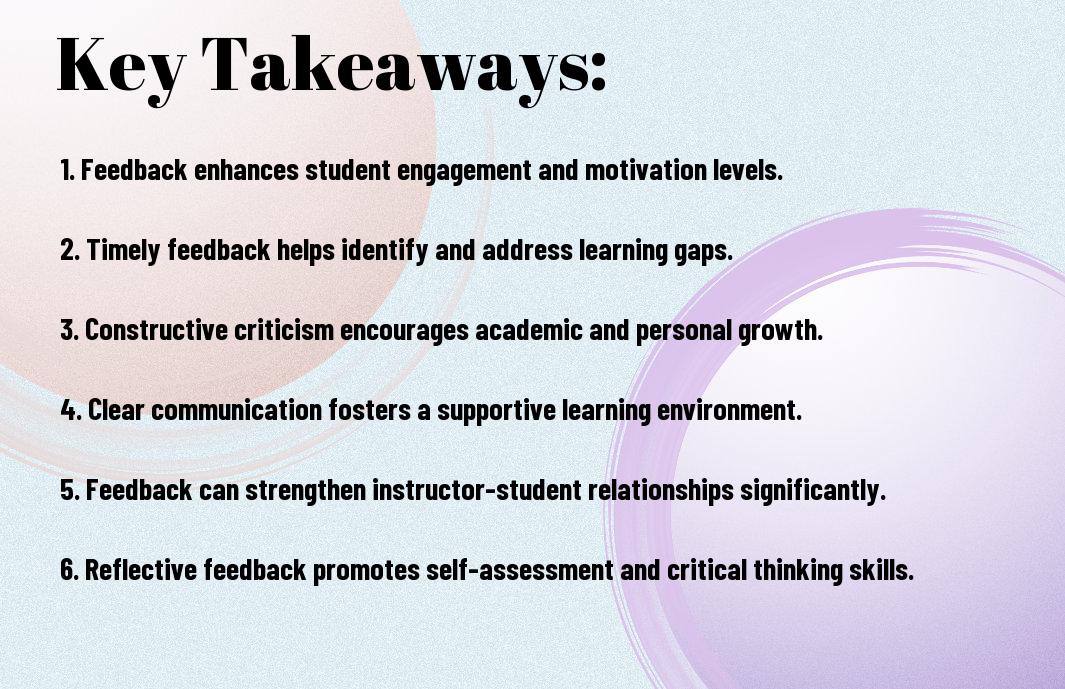
Key Takeaways:
- The use of Timely Feedback in online education is vital for enhancing student engagement and motivation, as it helps learners to track their progress and understand areas that need improvement.
- Constructive Feedback is crucial for online students, as it provides them with a clear understanding of their strengths and weaknesses, allowing them to adjust their learning strategies and achieve better outcomes.
- Personalized Feedback is key to meeting the diverse needs of online learners, as it enables instructors to tailor their feedback to individual students’ learning styles, abilities, and goals.
- The Quality of Feedback is more important than the quantity, as high-quality feedback that is specific, relevant, and actionable is more likely to have a positive impact on student learning and achievement.
- Using Technology-Enhanced Feedback tools, such as online quizzes, discussions, and peer review platforms, can facilitate the feedback process and provide online students with more opportunities to engage with feedback and reflect on their learning.
Benefits of Feedback
For online learners, feedback is imperative to track progress and identify areas that require improvement. You will find that feedback enhances your learning experience and helps you achieve your academic goals.
Improved Student Performance
Along with guiding your academic growth, feedback enables you to refine your skills and knowledge, leading to improved student performance and a stronger understanding of the subject matter.
Enhanced Learning Experience
Beside the academic benefits, feedback facilitates a more engaging and interactive learning environment, allowing you to take an active role in your education and make the most of your online learning experience.
To further enhance your learning experience, you can use feedback to reflect on your strengths and weaknesses, setting realistic goals and developing strategies to overcome challenges, ultimately leading to a more personalized and effective learning approach that suits your needs and learning style.
Types of Feedback
Assuming you are familiar with the concept of feedback, you can categorize it into different types. The main types are:
- Formative
- Summative
The following table summarizes the characteristics:
| Type | Description |
|---|---|
| Formative | Ongoing evaluation |
| Summative | Final assessment |
| Peer | Student assessment |
| Self-assessment | Personal evaluation |
| Teacher | Instructor feedback |
The information will help you understand the types of feedback.
Formative Feedback
Around the midpoint of your course, you will likely encounter formative feedback, which is designed to monitor your progress and provide guidance for improvement.
Summative Feedback
Around the end of your course, you will encounter summative feedback, which is a final evaluation of your performance.
Feedback is an necessary component of summative assessment, as it provides you with an overview of your strengths and weaknesses, allowing you to adjust your approach for future courses. You will find that summative feedback is often more detailed and comprehensive than formative feedback, as it aims to provide a thorough evaluation of your overall performance. You can use this feedback to reflect on your learning and identify areas for improvement, ultimately enhancing your academic experience.
Effective Feedback Strategies
Unlike traditional classroom settings, online education requires deliberate and strategic approaches to feedback. You will need to prioritize feedback to ensure students stay engaged and motivated, as it directly impacts their learning outcomes and overall educational experience.
Timely and Regular Feedback
Around the time you assign a task or project, consider implementing a feedback system that provides students with consistent and timely evaluations, allowing them to adjust and improve throughout the course.
Constructive and Specific Feedback
Among the various aspects of effective feedback, you should focus on delivering constructive and specific comments that target particular areas of improvement, enabling students to understand their strengths and weaknesses.
This type of feedback is particularly beneficial as it allows you to tailor your feedback to individual students’ needs, providing actionable advice and promoting a more personalized learning experience. You can achieve this by setting clear expectations, using specific examples, and emphasizing what students do well, thereby fostering a growth mindset and encouraging them to take ownership of their learning process.

Overcoming Challenges
All online educators face numerous challenges when implementing feedback in their courses, and you must be prepared to address them to ensure the success of your students.
Technical Issues
Around the clock, you will encounter technical problems that hinder the feedback process, and you should have a plan in place to resolve these issues promptly.
Instructor Workload
Alongside other responsibilities, you will need to manage your workload effectively to provide timely and constructive feedback to your students.
With careful planning and time management, you can mitigate the impact of a heavy workload on your ability to provide quality feedback, and you will be able to help your students achieve their full potential by giving them the feedback they need to succeed in your course.
Student Perspectives
Many students consider feedback to be an important component of online education, as it enables you to gauge your performance and adjust your approach accordingly. You can use feedback to identify areas where you need improvement and develop strategies to address these weaknesses.
Feedback and Motivation
The timely receipt of feedback has a profound impact on your motivation, as it allows you to track your progress and stay engaged with the course material. You will find that meaningful feedback boosts your confidence and encourages you to take an active role in your learning process.
Feedback and Self-Assessment
Beneath the surface of online education, you will discover that feedback plays a significant role in self-assessment, enabling you to evaluate your own learning and set realistic goals. You can use feedback to reflect on your strengths and weaknesses, and adjust your learning strategy to achieve your objectives.
Consequently, as you probe deeper into the concept of feedback and self-assessment, you will realize that it is a powerful tool for personal growth and development. You will be able to analyze your own learning, identify areas for improvement, and develop a sense of autonomy and self-directed learning, ultimately leading to a more effective and efficient learning experience.
Implementation and Evaluation
Now that you have understood the significance of feedback in online education, it is necessary to consider the implementation and evaluation of feedback strategies in your online courses.
Feedback Tools and Platforms
To facilitate effective feedback, you can utilize various tools and platforms that cater to your specific needs, such as learning management systems, online discussion forums, and video conferencing software.
Assessing Feedback Effectiveness
The effectiveness of your feedback strategies can be assessed by analyzing student outcomes, such as improved performance and increased engagement, which indicate the success of your feedback approaches.
In addition, as you evaluate the effectiveness of your feedback, you will be able to refine your strategies to better meet the needs of your students, ultimately enhancing the overall quality of your online education programs, and enabling you to make data-driven decisions to improve student learning outcomes.
Summing up
Following this exploration of online education, you now understand the significance of feedback in enhancing your learning experience. As you reflect on your own online courses, you will appreciate how timely and constructive feedback facilitates your progress, helping you to adjust your approach and achieve your academic goals. Your ability to receive and act upon feedback is crucial to maximizing the benefits of online education, enabling you to refine your skills and knowledge in a personalized and effective manner.
FAQ
Q: What is the role of feedback in online education and how does it impact student learning outcomes?
A: Feedback plays a significant role in online education as it enables students to gauge their understanding of the course material, identify areas of improvement, and adjust their learning strategy accordingly. Effective feedback from instructors helps students to stay motivated, develop a growth mindset, and achieve their academic goals. Furthermore, feedback facilitates a sense of community and connection in online courses, which can sometimes feel isolative. By providing timely and constructive feedback, instructors can foster a supportive learning environment that promotes student engagement, retention, and overall success.
Q: How can instructors provide high-quality feedback in online education, and what tools or strategies can they use to facilitate this process?
A: Instructors can provide high-quality feedback in online education by using a variety of tools and strategies. For instance, they can utilize learning management system (LMS) features such as discussion boards, video recordings, and annotation tools to provide personalized and timely feedback. Additionally, instructors can leverage audio and video feedback, which allows them to convey tone and nuance, making the feedback more effective and engaging. Moreover, instructors can use rubrics and grading criteria to ensure consistency and clarity in their feedback, and provide students with opportunities for self-assessment and peer review. By using these tools and strategies, instructors can facilitate a feedback-rich environment that supports student learning and development.
Q: How can students make the most of feedback in online education, and what are some best practices for using feedback to improve their learning outcomes?
A: Students can make the most of feedback in online education by being proactive and open to constructive criticism. They should regularly check the course website and LMS for feedback from instructors, and carefully review and reflect on the feedback they receive. Students can also use feedback to adjust their learning strategy, set new goals, and develop a plan to address areas of improvement. Furthermore, students can use feedback to engage in self-assessment and self-reflection, identifying their strengths and weaknesses, and developing a growth mindset. By using feedback in a purposeful and intentional way, students can take ownership of their learning, develop greater autonomy and self-directedness, and ultimately achieve greater success in their online courses.