Education

Are there free resources available for learning piano, and how effective are they

Effective learning of the piano doesn’t always have to come with a hefty price tag! You may be surprised to find a plethora of free resources online to kickstart your piano journey. From video tutorials on YouTube to interactive apps, these resources offer a cost-effective way to learn at your own pace. But, the burning question remains – just how effective are these free resources? Let’s dive in and explore the world of free piano learning tools to determine if they can truly help you master the piano without breaking the bank.

Key Takeaways:

  • Free resources for learning piano: There are numerous free resources available online for learning piano, including tutorials, sheet music, and video lessons.
  • Effectiveness of free resources: Free resources can be effective for beginners and those looking to learn basic concepts, but may lack the structure and depth provided by formal lessons.
  • Supplementing with paid instruction: While free resources can be helpful, supplementing with paid instruction from a qualified teacher can provide more personalized feedback and guidance for faster progress.
The Quest for Free Piano Resources

Are you looking for free resources to learn piano? You’re in luck! There are various platforms and websites that offer piano lessons online for free. If you want to explore some of the best options available, check out our article on Best Piano Lessons Online For Free: List of Top 10. These resources can be a great starting point for your piano learning journey without breaking the bank.

Online Platforms and Websites

Websites offering free piano lessons are abundant on the internet. Platforms like YouTube, Hoffman Academy, and Flowkey provide a wide range of tutorials for beginners as well as advanced learners. These platforms often have structured lesson plans, video tutorials, and even interactive tools to enhance your learning experience. While the quality of lessons may vary, you can find valuable resources to kickstart your piano practice.

Mobile Apps for Piano Learning

The world of mobile apps has also opened up new possibilities for learning the piano on the go. Apps like Simply Piano, Yousician, and Piano Maestro offer interactive lessons, feedback, and progress tracking right on your smartphone or tablet. These apps cater to different learning styles and provide a fun and engaging way to practice your piano skills whenever and wherever you want.

Platforms like Skoove and Playground Sessions offer comprehensive courses and real-time feedback to help you improve your piano playing. With features like interactive sheet music and AI-powered learning, these platforms can be a great addition to your practice routine.

Effectiveness of Free Resources

Pros: Accessibility and Convenience

While free resources for learning piano may not offer the same level of quality as paid lessons, they do have certain advantages. For starters, these resources are widely available online, making it easy for you to access them whenever you have the time. Whether you prefer video tutorials, interactive apps, or written guides, there is a wealth of free material at your disposal.

Additionally, free resources are convenient for those who have busy schedules or limited budgets. You can learn at your own pace, in the comfort of your own home, without having to worry about travel time or lesson costs. This flexibility allows you to fit piano practice into your life in a way that works best for you.

Cons: Lack of Personalized Feedback and Accountability

Accessibility and convenience come at a price when it comes to free resources for learning piano. One major downside is the lack of personalized feedback and accountability. Without a teacher to provide guidance and correct mistakes, you may unknowingly develop bad habits that can be difficult to unlearn later on. Additionally, without someone holding you accountable, you may struggle to stay motivated and consistent in your practice.

Another challenge of relying solely on free resources is the limited opportunities for interaction and collaboration with other learners. Learning piano is not just about playing the notes correctly but also about expressing emotion and interpreting music. Without feedback from others, you may miss out on valuable insights and perspectives that can help you grow as a musician.

Top Free Online Resources for Piano Learning

Despite the cost associated with formal piano lessons, there are several free online resources that can help you kickstart your piano learning journey. These resources, ranging from video tutorials to interactive piano simulators, can provide you with a solid foundation to build upon.

Video Tutorials and Lessons

Learning from video tutorials and lessons is a popular and effective way to grasp piano basics at your own pace. Platforms like YouTube offer a plethora of content created by skilled pianists and instructors. You can find tutorials on music theory, technique, specific songs, and more. These videos allow you to see and hear how to play, which can be immensely helpful in understanding the nuances of piano playing.

Interactive Piano Simulators and Games

Tutorials and games that involve interactive piano simulators are another great resource for those starting out on the piano. These tools often provide instant feedback on your playing, allowing you to track your progress and improve your skills. Some simulators even gamify the learning process, making it more engaging and enjoyable for you.

Another benefit of using interactive piano simulators and games is that they can help you practice consistently, as they are easily accessible online. This regular practice is crucial for developing muscle memory and finger dexterity, key components of piano playing.

Sheet Music and Scores

One of the crucial aspects of learning the piano is reading sheet music. Fortunately, there are numerous websites that offer free sheet music and scores for a wide range of songs, from classical to contemporary. By practicing with different pieces, you can enhance your sight-reading skills and expand your repertoire.

Video lessons and tutorials often complement sheet music by explaining how to interpret the notes and expressiveness of a piece. This integrated approach can deepen your understanding of music and help you become a well-rounded pianist.

Mobile Apps for Piano Learning

Many free resources exist to help you learn to play the piano, including mobile apps. If you’re looking for a comprehensive list of free resources, you can check out 7+ Legit Places to Find Free Piano Lessons for a starting point.

Popular Apps for Beginners

The world of piano learning apps is vast, with many options tailored specifically for beginners. These apps typically offer step-by-step lessons, interactive exercises, and even games to make learning fun and engaging. Some popular choices for beginners include:

App Description
Synthesia Offers a visual representation of songs to help beginners learn to play by ear.
Simply Piano by JoyTunes Provides interactive lessons and immediate feedback to guide beginners through the learning process.

Apps for Intermediate and Advanced Learners

For those with some experience under their belt, there are also apps designed to help intermediate and advanced learners take their skills to the next level. These apps may include features like advanced music theory lessons, challenging repertoire, and tools for improving technique. Some apps favored by intermediate and advanced learners are:

App Description
Yousician Offers a wide range of songs and exercises for players at different skill levels, including advanced players looking to refine their technique.
Flowkey Provides a vast library of classical and contemporary pieces for intermediate and advanced players to learn and master.

Features to Look for in a Piano Learning App

When choosing a piano learning app, there are several key features to consider to ensure it meets your needs. Some features to look out for include:

– Interactive lessons and exercises
– Progress tracking and feedback mechanisms
– A diverse repertoire of songs to learn
– Customizable practice schedules and goals

A good app will provide you with the tools and resources you need to progress in your piano playing journey effectively.

Limitations of Free Resources

After exploring the various free resources available for learning piano, it is important to understand their limitations. While these resources can provide a good starting point for beginners, they may not offer everything you need to become a proficient player. In this section, we will discuss two key limitations of free resources: the importance of human feedback and guidance, and the role of practice and dedication.

The Importance of Human Feedback and Guidance

To truly excel in playing the piano, having human feedback and guidance is necessary. While free resources such as online tutorials and apps can provide instructions, they lack the personalized feedback that a teacher can offer. A teacher can pinpoint your strengths and weaknesses, provide tailored exercises, and offer encouragement and support along your learning journey. This human interaction is invaluable in helping you overcome obstacles, stay motivated, and make steady progress in your piano playing.

The Role of Practice and Dedication

Resources alone cannot make you a skilled pianist; it is your dedication and practice that will ultimately determine your progress. While free resources can provide you with lessons and exercises, it is up to you to consistently practice and apply what you have learned. Becoming proficient at playing the piano requires hours of focused practice, patience, and perseverance. It is important to set aside regular practice time, stay disciplined in your routine, and challenge yourself to improve with each session.

Importance: Remember that while free resources can be a helpful starting point, your commitment to regular practice and dedication to honing your skills are key factors in your journey to mastering the piano.

Combining Free Resources with Paid Options

All the free resources available for learning the piano are fantastic starting points, but combining them with paid options can take your learning to the next level. By incorporating a mix of both, you can ensure a more comprehensive and structured approach to mastering the piano.

Supplementing Free Resources with Private Lessons

Free resources can provide you with a solid foundation in piano basics, but if you’re looking to refine your skills and receive personalized feedback, incorporating private lessons into your learning journey can be highly beneficial. Private instructors can offer tailored guidance, correct your technique, and help you progress more efficiently.

Using Free Resources to Prepare for Paid Courses

Private

If you’re considering enrolling in a paid piano course or program, utilizing free resources beforehand can be a great way to prepare yourself. By familiarizing yourself with basic concepts, techniques, and music theory through free online tutorials and resources, you can enter your paid course with a stronger understanding and a head start on the material. This can help you make the most out of your paid learning experience and progress more quickly.

Conclusion

Summing up, there are many free resources available for learning piano online, ranging from video tutorials on YouTube to sheet music websites and piano apps. These resources can be very effective in helping you improve your piano skills, as long as you are dedicated, patient, and willing to put in the time and effort to practice regularly.

Be mindful of, while these free resources can be incredibly helpful, they should not replace the guidance of a qualified piano teacher. If you are serious about learning the piano and want to reach a high level of proficiency, consider investing in proper lessons to ensure you are developing good technique and receiving personalized feedback on your progress. With a combination of free resources and professional guidance, you can go far in your piano journey.

Q: Are there free resources available for learning piano?

A: Yes, there are several free resources available for learning piano online. Websites such as YouTube, Simply Piano, and PianoLessons.com offer free tutorials, lessons, and sheet music for beginners and intermediate players.

Q: How effective are these free resources for learning piano?

A: The effectiveness of free resources for learning piano varies depending on the individual’s learning style and dedication. While these resources can be helpful in getting started and learning basic techniques, they may not offer the same level of personalized instruction and feedback as formal lessons with a teacher.

Q: What are some limitations of relying solely on free resources for learning piano?

A: Some limitations of relying solely on free resources for learning piano include lack of personalized feedback, progression tracking, and structured lesson plans. Additionally, free resources may not cover more advanced techniques or music theory in as much depth as formal lessons with a teacher.
How important is it to have a real piano or keyboard for online learning

Many of you may be wondering how crucial it is to have a real piano or keyboard for your online learning journey. In this informative post, we will investigate into the significance of having a physical instrument versus digital alternatives when it comes to mastering the art of playing the piano or keyboard remotely. Let’s uncover the benefits of tactile feedback, sound authenticity, and the overall learning experience that a real piano or keyboard can offer you in your virtual music education.

Key Takeaways:

  • Real Piano or Keyboard is Beneficial: Having a real piano or keyboard can enhance the learning experience by providing better touch sensitivity and sound quality.
  • Not Mandatory: While it is beneficial to have a real piano or keyboard, it is not mandatory for online learning. Virtual pianos and keyboards can be used as alternatives.
  • Personal Preference: The decision to use a real piano or keyboard for online learning ultimately depends on personal preference, budget, and available resources.

The Benefits of Real Pianos

Tactile Experience

Benefits of having a real piano for online learning extend beyond just the visual and auditory aspects. One significant advantage is the tactile experience that a traditional piano provides.
As you play on the keys of a real piano, you can feel the weight and resistance of each key, allowing you to develop proper finger strength and technique. This physical interaction with the instrument enhances muscle memory and can contribute to a more expressive and controlled performance.

Better Sound Quality

Pertaining to sound quality, real pianos offer a depth and richness that digital keyboards may struggle to replicate. The acoustic sound produced by the strings and hammers of a real piano creates a unique tonal quality that can be more resonant and dynamic.
Having a real piano at your disposal allows you to explore a wider range of musical expression, from delicate pianissimos to powerful fortissimos, with nuances that digital keyboards may not capture as authentically.

Real pianos also provide natural acoustics that fill the room with warmth and texture, enhancing your overall playing experience. The subtleties of tone and resonance produced by a real piano can inspire and elevate your musicality, making your online learning sessions more engaging and rewarding.

The Limitations of Digital Keyboards

Lack of Expression

Assuming you are learning to play the piano online, one limitation of digital keyboards is the lack of expression they offer compared to a real piano. Digital keyboards often have fewer keys and less responsive touch sensitivity, which can hinder your ability to truly express yourself through your music. The nuanced dynamics and emotions that can be conveyed through a real piano may be harder to achieve on a digital keyboard.

Limited Dynamic Range

Digital keyboards also have a limited dynamic range, which refers to the range of volume levels you can produce while playing. With a digital keyboard, you may find it challenging to achieve the same level of softness or power in your playing compared to a real piano. This limitation can impact the depth and richness of your musical interpretation and performance.

With that being said, digital keyboards can still be a valuable tool for online learning, especially if a real piano is not accessible to you. They offer convenience and affordability, allowing you to practice and learn the basics of piano playing. However, it’s important to be aware of their limitations and work around them to continue developing your skills and musical expression.

Online Learning Platforms

Once again, when considering whether you need a real piano or keyboard for online learning, it’s crucial to look at the platform you will be using for your lessons. Some online platforms may offer specific features that require a real piano, while others may be more flexible. If you’re unsure about the requirements of the platform you’ve chosen, you can check their FAQ section or reach out to the platform provider for more information. To investigate deeper into this topic, you can also explore resources like Do I Need a Piano for Piano Lessons?.

Interactive Tools

To enhance your online learning experience, some platforms offer interactive tools that allow you to practice and receive feedback in real time. These tools may range from virtual keyboards that simulate the feel of a real piano to interactive sheet music that highlights the notes as you play. While these tools can be beneficial, they may work best with a real piano or keyboard to ensure a smooth and accurate learning process.

Virtual Lessons

For virtual lessons, having a real piano or keyboard can make a significant difference in the quality of your learning. Virtual lessons often involve live interaction with your instructor, who may need to hear your play in real time to provide feedback and guidance. With a real piano or keyboard, you can ensure that the sound quality is optimal, allowing your instructor to assess your progress accurately and offer tailored instruction to help you improve.

The Importance of Feedback

All learning, especially when it comes to mastering a musical instrument like the piano, requires timely and constructive feedback. Immediate Correction is crucial when learning online, as it helps you identify and correct mistakes right away, preventing them from becoming ingrained habits. With a real piano or keyboard, you can more accurately assess your playing and make adjustments in real-time.

Immediate Correction

Immediate Correction is crucial for your progress in online piano learning. With a real piano or keyboard, you can hear the nuances in your playing and receive instant feedback on your technique. This allows you to make corrections immediately, leading to faster improvement and a more accurate understanding of your playing.

Developing Muscle Memory

Importance of developing muscle memory cannot be overstated when learning to play the piano. Having a real piano or keyboard allows you to practice consistently and build muscle memory more effectively. Muscle memory is developed through repetition and practice, and having a tangible instrument helps solidify the connection between your fingers and the keys.

Furthermore, when you consistently practice on a real piano or keyboard, your muscles learn the proper movements and positions, making it easier for you to play without having to consciously think about each note. This automatic response is key to playing complex pieces fluently and effortlessly.

Cost and Accessibility

Unlike What is better online lessons or private for learning piano?, where the cost of traditional lessons can add up quickly due to travel expenses and instructor fees, online learning offers a more budget-friendly option for mastering the piano. With online platforms, you can access a wide range of lessons at varying price points or even find free resources to kickstart your musical journey.

Budget-Friendly Options

Cost is often a significant factor when deciding between a real piano or keyboard for online learning. Many online platforms offer subscription-based services that give you access to a library of lessons for a fraction of the cost of traditional private lessons. Additionally, you can find free tutorials and resources on platforms like YouTube to supplement your learning without breaking the bank.

Renting vs. Buying

With the accessibility of digital pianos and keyboards, you have the option to rent or buy an instrument for your online learning experience. Renting a piano can be a cost-effective solution, especially if you’re unsure about your long-term commitment to learning the instrument. On the other hand, purchasing a keyboard gives you the flexibility to practice at any time without the pressure of a rental deadline.

The decision between renting and buying ultimately depends on your personal circumstances and commitment to learning the piano. Renting can be a great way to test the waters and see if playing the piano is something you want to pursue further before investing in a permanent instrument.

Space and Portability

Not everyone has the luxury of space in their home for a full-sized acoustic piano. This is where the portability of a keyboard becomes a significant advantage for online learning. Keyboards are compact and can easily fit into smaller living spaces, making them the perfect choice for those with limited room.

Compact Keyboards

On the practical side, compact keyboards can be easily stored away when not in use, allowing you to optimize your space for other activities. Their lightweight design makes them portable enough to bring to different rooms or even outside for a change of scenery during your practice sessions.

Acoustic Piano Maintenance

For those who prefer the sound and feel of an acoustic piano, maintenance can be a significant consideration. Acoustic pianos require regular tuning and upkeep to ensure they sound their best. This can be both time-consuming and costly, as you will need to hire a professional piano tuner periodically to keep your instrument in top condition.

Acoustic pianos are also more susceptible to changes in temperature and humidity, which can affect their tuning and overall performance. You may need to invest in a humidifier or dehumidifier for your piano to maintain its stability, especially if you live in a climate with extreme variations.

To wrap up

With these considerations in mind, having a real piano or keyboard for online learning can greatly enhance your overall experience and progress. The tactile feedback, authentic sound quality, and ergonomic design of a real instrument can provide a more immersive and engaging learning environment, ultimately helping you stay motivated and focused on your musical journey. While digital keyboards can offer convenience and versatility, investing in a real piano or high-quality keyboard may be worth considering for serious learners looking to develop their skills and musicality to a higher level.

FAQ

Q: Is it important to have a real piano or keyboard for online learning?

A: It is not absolutely necessary to have a real piano or keyboard for online learning, but it can greatly enhance your learning experience. Having a real instrument allows for better playing technique, sound quality, and a more authentic playing experience.

Q: Can I use a digital keyboard or MIDI controller for online piano lessons?

A: Yes, you can use a digital keyboard or MIDI controller for online piano lessons. These instruments are more affordable and portable than real pianos, making them a convenient option for online learning. However, keep in mind that the key action and sound quality may differ from a real piano.

Q: What are the advantages of using a real piano for online learning?

A: Using a real piano for online learning can offer advantages such as developing proper finger strength and technique, getting accustomed to the weight and feel of piano keys, and producing a richer and more realistic sound. It can also help you transition more easily to playing on acoustic pianos in the future.

Can you learn piano effectively using a MIDI keyboard connected to a computer

It’s time to explore whether you can master the piano using a MIDI keyboard paired with your computer. Unlock the secrets of this innovative learning method, as we probe into the effectiveness, benefits, and potential drawbacks of this modern approach. Let’s discover how you can enhance your musical journey with technology at your fingertips.

Key Takeaways:

  • Convenience: MIDI keyboard connected to a computer offers a convenient way to learn piano at home.
  • Interactive Learning: MIDI keyboards can provide instant feedback and track your progress, enhancing the learning experience.
  • Versatility: You can access various online resources, such as tutorials and software, to enhance your piano learning experience with a MIDI keyboard and computer setup.

The Basics of MIDI Keyboards

What is a MIDI Keyboard?

Basics: Your MIDI keyboard is a versatile musical instrument that uses the Musical Instrument Digital Interface (MIDI) technology to communicate with other devices such as computers. Unlike traditional pianos, MIDI keyboards do not produce sounds on their own. Instead, they send signals about which keys are pressed and how hard they are pressed to a connected device, such as a computer or synthesizer, which then generates the sounds.

How Does it Connect to a Computer?

Does: To connect your MIDI keyboard to a computer, you will need a USB cable that plugs into both the keyboard and the computer. Most modern MIDI keyboards come equipped with USB connectivity, making it easy to set up and start playing. Once connected, your computer will recognize the MIDI keyboard as a MIDI input device, allowing you to use it with music production software or other virtual instruments.

This seamless integration between your MIDI keyboard and computer opens up a world of possibilities for learning and creating music. You can access a wide range of sounds, record your performances, and even receive feedback on your playing technique, all through the connection between your MIDI keyboard and computer.

Advantages of Learning Piano with a MIDI Keyboard

Little do you know that learning piano with a MIDI keyboard connected to a computer can offer you a plethora of advantages. Not only does it provide a convenient way to practice and improve your skills, but it also opens up a world of possibilities for your musical journey. If you’re looking to examine into piano playing using modern technology, there are several benefits that come with this setup.

Cost-Effective

On Easy to Implement Tips on How to Learn and Play Piano …, you’ll find that using a MIDI keyboard with your computer for piano learning is incredibly cost-effective. Instead of investing in a traditional acoustic piano or even a digital piano, which can be quite expensive, all you need is a MIDI keyboard and a computer. This setup allows you to access a wide range of piano sounds and lessons without breaking the bank.

Space-Saving

One of the major advantages of learning piano with a MIDI keyboard is the space-saving aspect. Unlike traditional pianos that take up a significant amount of room in your home, a MIDI keyboard is compact and can easily fit on a desk or table. This makes it ideal for those living in smaller spaces or apartments where a full-sized piano may not be practical.

For instance, if you’re a student living in a dorm room or someone with limited space, a MIDI keyboard offers the flexibility to practice and play without the need for a large instrument taking up valuable real estate in your living area.

Versatility in Sound Options

The versatility in sound options is another compelling advantage of using a MIDI keyboard for your piano learning journey. The ability to connect your MIDI keyboard to your computer opens up a world of virtual instruments and different piano sounds at your fingertips. Whether you prefer a grand piano sound, an electric piano tone, or even experimental sounds, you can easily explore and play around with various options to suit your preferences.

It allows you to experiment with different sounds and styles, helping you develop a unique playing style and expanding your musical horizons. This versatility in sound options adds a layer of creativity and excitement to your piano practice sessions, keeping you engaged and motivated to learn and improve.

Effective Learning Techniques

Practicing with Interactive Software

Not all practice sessions are created equal. To make the most of your time spent playing the piano with a MIDI keyboard and computer setup, it’s crucial to engage with interactive software that provides feedback on your performance. Effective learning means using tools that can identify areas for improvement and offer guidance on how to enhance your skills.

Recording and Analyzing Your Progress

Not only does recording your practice sessions allow you to track your progress over time, but it also serves as a valuable tool for self-assessment. By listening back to your recordings, you can pinpoint where you excel and where you need to concentrate your efforts. Effective learning involves a cycle of recording, listening, analyzing, and applying changes to refine your piano skills.

Another benefit of recording and analyzing your progress is the ability to set specific goals based on your observations. Whether it’s improving your timing, dynamics, or overall performance, having concrete data from your recordings can help you create a targeted practice plan to achieve your musical objectives.

Access to Online Resources and Tutorials

The wealth of online resources and tutorials available for piano learning can provide you with a well-rounded education. From video lessons to interactive exercises, these resources offer additional support to enhance your learning experience. The convenience of accessing a variety of materials online allows you to supplement your MIDI keyboard practice and gain insights from different instructors.

Interactive tutorials can also help reinforce concepts learned during your practice sessions. By engaging with online materials that offer real-time feedback and demonstrations, you can solidify your understanding of key techniques and theory. The accessibility of online resources ensures that you have a diverse range of learning tools at your disposal to enhance your piano skills effectively.

Overcoming Common Challenges

Adjusting to a Non-Acoustic Feel

After making the switch from playing on an acoustic piano to a MIDI keyboard connected to your computer, you may find that adjusting to the non-acoustic feel can be challenging. The lack of weighted keys and the different tactile feedback can initially throw off your playing. However, with practice and patience, you can adapt to the new feel and even appreciate the benefits it offers.

Limited Dynamic Range

To tackle the limited dynamic range of a MIDI keyboard compared to an acoustic piano, you may face challenges in expressing musical nuances in your playing. While MIDI keyboards offer a more consistent sound across all velocity levels, they may lack the depth and richness of sound that acoustic pianos provide. This can make it challenging to convey emotions effectively through your music.

Challenges in mastering the limited dynamic range of a MIDI keyboard can be overcome with careful attention to your playing technique. By practicing varying touch and pressure on the keys, you can learn to create nuances in dynamics that emulate the expressiveness of an acoustic piano. Utilizing the MIDI keyboard’s features, such as adjusting velocity curves and using expression pedals, can also help you expand your dynamic range and musical expression.

Building Hand-Eye Coordination

Overcoming the challenge of building hand-eye coordination when using a MIDI keyboard connected to a computer is crucial for improving your playing skills. The absence of physical keys and the reliance on visual cues on a screen can disrupt your natural hand-eye coordination developed from playing on an acoustic piano. However, with focused practice and exercises, you can enhance your hand-eye coordination and adapt to the digital interface.

Building hand-eye coordination with a MIDI keyboard involves practicing hand placement, finger positioning, and visual tracking of notes displayed on the screen. Techniques such as sight-reading exercises and memorizing key placements can strengthen your coordination skills and improve your ability to play accurately and fluently on a digital platform. By incorporating consistent practice routines and challenging yourself with different pieces, you can effectively enhance your hand-eye coordination and navigate the virtual piano space with confidence.

Choosing the Right MIDI Keyboard for Learning Piano

Key Count and Size

To make the most out of your piano learning experience with a MIDI keyboard, consider the size and key count that best suits your needs. The standard piano has 88 keys, but if you’re a beginner or have limited space, a keyboard with 61 keys can suffice. However, keep in mind that a full-sized keyboard allows you to practice and play a wider range of songs.

Weighted vs. Unweighted Keys

When dicking out a MIDI keyboard for piano learning, it’s important to decide between weighted and unweighted keys. Weighted keys simulate the feel of an acoustic piano, providing the necessary resistance to build finger strength and technique. On the other hand, unweighted keys are more lightweight and suitable for beginners or those focusing on synthesizer sounds.

Weighted keys give you a realistic playing experience and are recommended for those who want to develop proper finger technique and dynamics while unweighted keys are easier to play and may be preferable if you’re just starting out or interested in a more versatile MIDI keyboard.

Additional Features for Learning

Look for MIDI keyboards with additional features that can enhance your piano learning journey. Features like touch sensitivity, which allows the keyboard to respond to the force of your playing, or built-in lessons and tutorials can be beneficial for your progress. Some MIDI keyboards also come with connectivity options for music software, providing access to a wealth of learning resources and virtual instruments.

Plus, consider a MIDI keyboard with programmable drum pads or sliders and knobs that can be assigned to various functions in your music software. These additional features can help you explore different sounds, effects, and techniques while learning to play the piano with your MIDI keyboard.

Tips for Maximizing Your Practice Sessions

Once again, to make the most of your practice sessions, here are some tips and tricks for you to consider:

Setting Realistic Goals and Schedules

Your piano journey will be more effective if you set realistic goals and create a practice schedule that fits your lifestyle. Break down your long-term goals into smaller, achievable milestones to track your progress. Additionally, establish a consistent practice routine that aligns with your daily schedule, ensuring regular and focused practice sessions.

This approach will help you stay on track and motivated as you witness your improvement with each practice session. By setting achievable goals and maintaining a consistent practice schedule, you can enhance your learning experience and make significant progress in your piano skills.

Creating a Conducive Practice Environment

The environment in which you practice plays a crucial role in your learning process. Ensure that your practice space is free from distractions and is comfortable to enhance your focus and concentration. Organize your music sheets, set up your MIDI keyboard in a well-lit area, and eliminate any potential interruptions.

This will create a conducive atmosphere for learning and practicing the piano. By optimizing your practice environment, you can create a space that nurtures your musical development and allows you to immerse yourself fully in your practice sessions.

Staying Motivated and Engaged

Conducive to staying motivated and engaged throughout your piano learning journey is cultivating a positive mindset and finding joy in the process. Celebrate your achievements, no matter how small, and maintain a sense of curiosity and exploration in your practice. Engage with a variety of musical genres and pieces to keep your practice sessions dynamic and exciting.

Engaged with your progress and seek inspiration from fellow musicians or performances to fuel your passion for learning the piano. By staying motivated and engaged, you can sustain your enthusiasm for practicing and continue to develop your skills effectively.

Conclusion

With this in mind, using a MIDI keyboard connected to a computer can be a highly effective way for you to learn how to play the piano. The accessibility of online resources, the versatility of MIDI keyboards, and the feedback provided by digital programs all contribute to a rich and engaging learning experience. By incorporating technology into your music education, you can tailor your practice sessions to your needs and goals, making your learning journey more efficient and enjoyable.

So, whether you’re a beginner just starting out or an experienced player looking to improve your skills, utilizing a MIDI keyboard connected to a computer can be a valuable tool in your musical journey. With dedication, practice, and the right resources, you can unlock your full potential as a pianist and enjoy the process of learning and creating music in a whole new way.

Q: Can you learn piano effectively using a MIDI keyboard connected to a computer?

A: Yes, you can learn piano effectively using a MIDI keyboard connected to a computer. MIDI keyboards are designed to replicate the feel and sound of a traditional piano, making it a great tool for learning and practicing piano skills.

Q: What are the benefits of using a MIDI keyboard for learning piano?

A: Using a MIDI keyboard connected to a computer offers several benefits for learning piano, including access to virtual instruments and software that can enhance your learning experience. It also allows for easy recording and playback of your playing, helping you track your progress over time.

Q: Are there any disadvantages to learning piano with a MIDI keyboard?

A: While learning piano with a MIDI keyboard connected to a computer can be effective, there are some limitations. MIDI keyboards may not replicate the exact feel and sound of a traditional piano, which can impact your technique development. Additionally, relying solely on virtual instruments may limit your exposure to different piano tones and dynamics.

What are the benefits of using video tutorials for learning piano

Tutorials can be incredibly helpful when it comes to learning the piano. By utilizing video tutorials, you have the advantage of visual and auditory cues that can enhance your understanding and retention of musical concepts. You can pause, rewind, and practice at your own pace, tailoring your learning experience to suit your needs. Additionally, video tutorials often offer demonstrations and tips that can help you improve your technique and overall musicality. So why not take advantage of the convenience and wealth of knowledge that video tutorials provide to enhance your piano learning journey? It’s time to press play and unlock your musical potential!

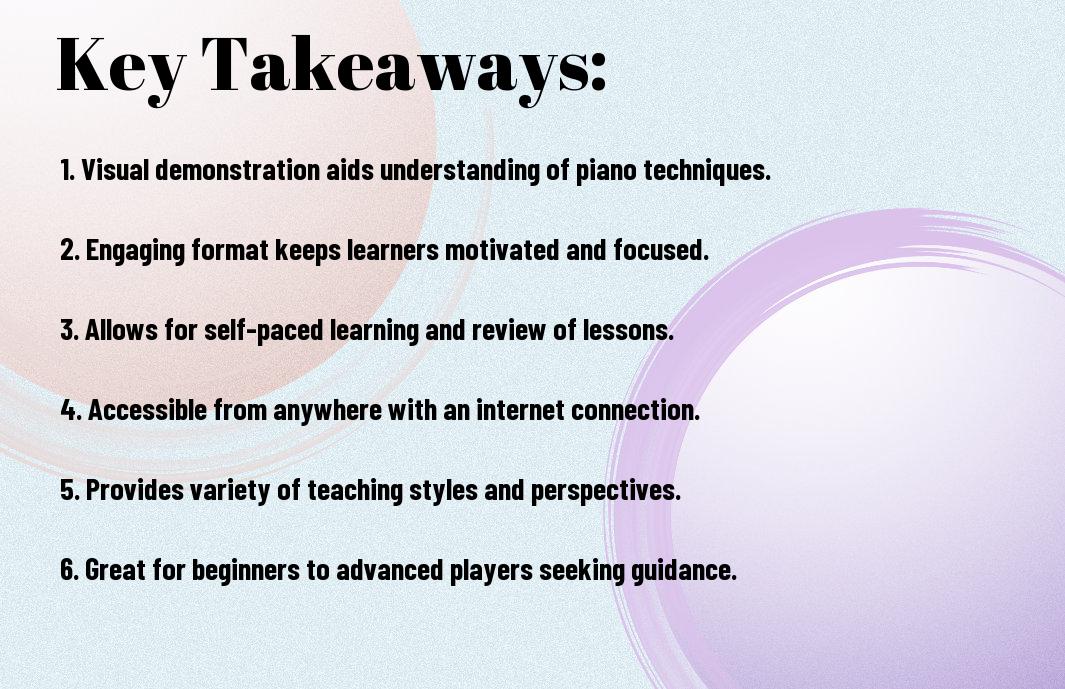
Key Takeaways:

  • Visual and auditory learning: Video tutorials provide a combination of visual demonstrations and auditory explanations, catering to different learning styles and making it easier to understand piano techniques.
  • Self-paced learning: Learners can pause, rewind, and replay video tutorials at their own convenience, allowing them to practice and master piano skills at their own pace without feeling rushed.
  • Access to diverse resources: Video tutorials offer a wide range of lessons, from beginner to advanced levels, and cover various genres of music, providing learners with a diverse set of resources to enhance their piano learning experience.

Enhanced Engagement

A key benefit of using video tutorials for learning piano is the enhanced engagement they offer. As a budding pianist, you’ll find yourself more engaged in the learning process when watching video tutorials compared to traditional methods.

Visual Learning

With video tutorials, you can visually see how a piece should be played. This visual aid can significantly enhance your learning experience by providing a clear demonstration of hand positioning, finger movement, and overall technique.

Interactive Experience

For an interactive experience, video tutorials often include features like on-screen annotations, highlighted keys, slow-motion playback, and interactive quizzes. These interactive elements not only keep you engaged but also help reinforce your understanding of the lesson material.

It allows you to pause, rewind, and replay sections as needed, ensuring that you fully grasp each concept before moving on to the next. This hands-on approach to learning can accelerate your progress and boost your confidence as you master new songs and techniques.

Personalized Learning

There’s a sense of empowerment that comes with personalized learning when using video tutorials to learn piano. You have the freedom to progress at your own pace, tailoring your learning experience to fit your individual needs and schedule.

Self-Paced Progress

To enhance your learning experience, video tutorials allow you to control the pace of your progress. You can pause, rewind, or fast forward through lessons as needed, ensuring that you fully understand each concept before moving on to the next. This flexibility enables you to focus more on challenging sections and breeze through topics you find easier, ultimately helping you build a strong foundation in piano playing.

Review and Repeat

To solidify your understanding and skills, you can review and repeat lessons as many times as necessary with video tutorials. Whether you’re struggling with a specific technique or want to master a particular piece, you can revisit the material until you feel confident and proficient. This ability to practice and reinforce your learning through repetition is invaluable in honing your piano skills.

A key advantage of video tutorials for learning piano is the opportunity to review and repeat lessons effortlessly. By going over challenging parts multiple times, you can refine your technique and improve your playing accuracy. This focused practice not only boosts your confidence but also enhances your overall performance as a pianist.

Improved Retention

Now, let’s explore into how video tutorials can enhance your retention of piano lessons. This is crucial for mastering new skills and concepts efficiently.

Multisensory Approach

For improved retention, video tutorials offer a multisensory approach to learning. By combining visual, auditory, and sometimes even kinesthetic elements, these tutorials engage multiple senses simultaneously, reinforcing your understanding and memory retention. When you see the instructor’s hand placements on the piano keys, hear the music being played, and follow along with your own hands, you create stronger neural connections in your brain, making it easier to recall the information later on.

Reduced Information Overload

Any piano student knows that learning to play the piano involves processing a vast amount of information simultaneously – reading sheet music, coordinating both hands, and understanding musical theory. Video tutorials help break down complex information into digestible segments, reducing the risk of information overload. By pausing, rewinding, and replaying the video as needed, you can learn at your own pace without feeling overwhelmed. The visual demonstration provided in video tutorials also clarifies difficult concepts and techniques, making them easier to grasp and remember.

The reduced information overload achieved through video tutorials allows you to focus on one aspect at a time, gradually building your skills and knowledge without feeling rushed or inundated with too much information. This methodical approach not only improves your retention of piano lessons but also boosts your confidence as you see tangible progress in your learning journey.

Increased Accessibility

Learning at Your Own Convenience

Convenience is a significant advantage of using video tutorials for learning piano. After a long day at work or school, you can simply log in to your online piano lesson whenever it suits you best. Whether you are a morning person or a night owl, you have the flexibility to choose when to practice without being tied to a set schedule.

No Need for a Physical Instructor

Increased accessibility to piano learning comes with the benefit of not needing a physical instructor. With video tutorials, you have the freedom to learn at your own pace and revise lessons as many times as you need. You can pause, rewind, and replay the tutorial until you master the technique without feeling rushed or pressured by a teacher’s presence.

Cost-Effective

Reduced Costs Compared to Private Lessons

For those looking to learn piano on a budget, video tutorials offer a cost-effective alternative to traditional private lessons. Private lessons can be quite expensive, with hourly rates that quickly add up over time. On the other hand, video tutorials often have a one-time or subscription-based fee, giving you access to a wealth of lesson content without breaking the bank.

Private Lessons Video Tutorials
Expensive hourly rates Affordable one-time or subscription fees
Limited flexibility in scheduling Learn at your own pace and convenience
Restricted to local instructors Access a global network of instructors

Access to a Wide Range of Tutorials

To broaden your piano learning experience, video tutorials provide you with access to a diverse array of lessons and styles. Whether you are a beginner seeking basic music theory guidance or an intermediate player looking to master complex compositions, video tutorials cater to a wide range of skill levels and musical interests. This variety allows you to explore different teaching methods and find the ones that resonate best with your learning style.

This wide range of tutorials also gives you the opportunity to learn from multiple instructors around the world, each bringing their unique expertise and perspective to the table. By exposing yourself to various teaching approaches, you can gain a more comprehensive understanding of piano techniques and musical interpretations, enriching your overall learning experience.

Flexibility and Adaptability

Learning Styles Accommodated

Unlike traditional piano lessons that follow a rigid structure, video tutorials offer you the flexibility to cater to your unique learning style. Whether you are a visual learner who thrives on watching demonstrations, an auditory learner who prefers listening to instructions, or a kinesthetic learner who learns best through hands-on practice, video tutorials can accommodate your individual preferences. This adaptability ensures that you can grasp the concepts more effectively and progress at a pace that suits your learning style.

Adjusting to Individual Progress

An additional benefit of video tutorials is their ability to adjust to your individual progress. As you evolve and improve in your piano skills, you can easily revisit specific lessons or skip ahead to more advanced topics. This personalized approach allows you to tailor your learning journey according to your development, ensuring that you are continuously challenged and engaged. With video tutorials, you have the freedom to navigate through the content at your own pace, making the learning process more dynamic and rewarding.

Plus, video tutorials often include interactive elements such as quizzes, exercises, and progress tracking features. These tools not only help you assess your understanding and progress but also provide immediate feedback to enhance your learning experience. By incorporating these interactive components, video tutorials offer a more holistic approach to piano education, promoting both skill acquisition and comprehension.

Final Words

From above, you have seen the myriad benefits that video tutorials offer for learning piano. The visual and auditory cues, step-by-step instruction, flexibility, and accessibility make them a valuable resource for beginners and experienced pianists alike. The convenience of learning at your own pace, in the comfort of your own home, combined with the wealth of free resources available online, presents a compelling case for incorporating video tutorials into your piano learning journey. However, if you’re still wondering if it’s possible to learn piano just from YouTube videos, you might find this Reddit discussion insightful.

Q: What are the benefits of using video tutorials for learning piano?

A: Video tutorials offer visual demonstrations that can help learners better understand piano techniques and movements. They provide a flexible learning schedule, allowing students to pause, rewind, and replay sections as needed. Additionally, video tutorials often cater to learners of all levels, from beginners to advanced pianists, offering a wide range of topics and styles.

Q: How can video tutorials enhance my piano learning experience?

A: Video tutorials can enhance your piano learning experience by offering step-by-step instructions, interactive demonstrations, and real-time feedback. They can also introduce you to different teaching styles and perspectives, helping you develop a well-rounded understanding of piano playing. Moreover, video tutorials often provide a sense of community and connection with other learners through online forums and social media groups.

Q: What are some other advantages of using video tutorials for learning piano?

A: Additional benefits of using video tutorials for learning piano include cost-effectiveness compared to in-person lessons, the ability to learn at your own pace and in the comfort of your own home, and access to a diverse range of expert instructors from around the world. Video tutorials can also help you stay motivated and inspired by showcasing performances, improvisation techniques, and creative ways to approach piano playing.

How do interactive piano learning platforms enhance the learning experience

With the rise of technology, interactive piano learning platforms offer a dynamic way to enhance your learning experience. By incorporating features like real-time feedback, interactive lessons, and gamified practice sessions, these platforms provide a personalized approach to learning the piano. Discover how these tools can transform your piano learning journey and help you reach your musical goals more effectively.

Key Takeaways:

  • Engagement: Interactive piano learning platforms offer engaging features like gamification, progress tracking, and instant feedback to keep students motivated and interested.
  • Personalized Learning: These platforms use AI algorithms to personalize lessons according to individual progress, learning styles, and goals, providing a tailored learning experience.
  • Convenience: Learners can access interactive piano lessons anytime, anywhere, allowing for flexibility in practicing and learning at their own pace.

The Evolution of Piano Learning

Traditional Methods: Limitations and Drawbacks

For centuries, traditional methods of learning the piano have been the cornerstone of music education. These methods often involve one-on-one lessons with a teacher, practicing scales and exercises, and learning music theory. While this approach has its merits, it also comes with limitations. Personalized attention from a teacher can be expensive and not always accessible for everyone. Additionally, the rigid structure of traditional lessons may not cater to individual learning styles and pacing, leading to potential frustration and lack of engagement.

The Rise of Interactive Platforms: A New Era in Music Education

An exciting development in piano learning has been the rise of interactive platforms that offer a more engaging and accessible way to learn music. These platforms use technology to provide interactive lessons, feedback, and practice tools that cater to different learning styles. You can now learn the piano at your own pace, anytime and anywhere, with the help of virtual instructors and gamified learning experiences. This new era in music education is revolutionizing the way people learn piano, making it more enjoyable and effective than ever before.

Piano learning platforms leverage multimedia elements, such as videos, interactive sheet music, and performance analysis tools, to enhance your learning experience. You can receive instant feedback on your playing, track your progress over time, and even participate in online communities to share your achievements and seek advice from fellow learners. These interactive features not only make learning the piano more fun and engaging but also accelerate your progress and mastery of the instrument.

Engaging Interactivity

Gamification: Making Practice Fun and Competitive

Some people find traditional piano practice mundane and repetitive, leading to reduced motivation and progress. Interactive piano learning platforms often incorporate gamification elements to make practicing more enjoyable and engaging. By turning practice sessions into games or challenges, you are more likely to stay focused and committed to your learning goals. The element of competition, whether with yourself or others, can add an extra layer of excitement to your practice routine.

Real-time Feedback: Personalized Guidance for Improved Progress

On interactive piano platforms, real-time feedback is a game-changer in your learning journey. As you play along, the platform can analyze your performance instantly and provide personalized guidance to help you correct mistakes and improve your skills. This immediate feedback loop not only saves you time but also ensures that you are practicing effectively, targeting areas that need the most work. With this personalized guidance, you can monitor your progress more efficiently and tailor your practice sessions for maximum improvement.

Another benefit of real-time feedback is the ability to track your progress over time. By reviewing your performance data and practice history, you can identify patterns, set specific goals, and measure your improvement accurately. This feature not only keeps you motivated but also provides a clear roadmap for your piano learning journey.

Accessible Learning

Convenience and Flexibility: Learning at Your Own Pace

The interactive piano learning platforms offer you the convenience and flexibility to learn at your own pace. Unlike traditional lessons with strict schedules, you have the freedom to practice whenever you want, whether it’s early morning or late at night. This flexibility allows you to fit piano lessons seamlessly into your busy schedule without the stress of rushing to make it to a class on time.

The interactive nature of these platforms also means that you can pause, rewind, and replay lessons as many times as you need until you fully grasp the concept. This personalized approach to learning ensures that you can take your time to master each skill before moving on to the next, leading to a more successful and fulfilling learning experience.

Democratizing Music Education: Reaching a Wider Audience

Accessible to anyone with an internet connection, interactive piano learning platforms are democratizing music education by reaching a wider audience. Whether you’re a beginner or an advanced player, these platforms provide a level playing field for anyone interested in learning the piano. You no longer need to have access to expensive private lessons or prestigious music schools to enhance your musical skills.

With interactive piano learning platforms, geographical barriers are eliminated, allowing individuals from all corners of the world to access high-quality music education. This inclusivity not only expands the reach of music education but also fosters a diverse and vibrant community of learners passionate about honing their piano skills.

Enhanced Retention and Recall

After exploring interactive piano learning platforms, you will discover how they enhance the retention and recall of musical concepts and skills. These platforms offer a variety of features and tools designed to make learning more engaging, effective, and memorable.

Interactive Exercises: Reinforcing Musical Concepts and Skills

Musical concepts can be reinforced through interactive exercises that test your knowledge and understanding of key principles such as music theory, rhythm, and technique. By actively engaging with these exercises, you are not only learning new concepts but also reinforcing them through practice and application. This hands-on approach helps solidify your understanding and improves your ability to recall information when playing the piano.

Spaced Repetition: Optimizing Practice for Long-term Retention

An important feature of interactive piano learning platforms is spaced repetition, a learning technique that involves revisiting and practicing musical concepts at strategically spaced intervals. This method is proven to enhance long-term retention by optimizing the way you practice and review material. By spacing out your practice sessions and revisiting previously learned concepts over time, you strengthen your memory and improve your ability to recall information in the future.

Another benefit of spaced repetition is that it helps prevent forgetting and ensures that you retain the knowledge and skills you have acquired during your piano lessons. By incorporating spaced repetition into your practice routine, you can maximize your learning potential and make faster progress in your musical journey.

Personalized Learning Paths

Adaptive Technology: Tailoring Instruction to Individual Needs

Learning on interactive piano platforms is a personalized journey, with adaptive technology that tailors instruction to your individual needs. These platforms utilize algorithms to assess your playing abilities and learning pace, allowing you to progress at a pace that is just right for you. This personalized approach ensures that you are neither overwhelmed with material that is too advanced nor bored by content that is too easy. As you practice and play, the platform continuously adjusts the difficulty level to keep you challenged and engaged.

Identifying Strengths and Weaknesses: Focused Practice for Rapid Progress

Learning on interactive platforms involves identifying your strengths and weaknesses through focused practice strategies aimed at rapid progress. By analyzing your performance data, these platforms can pinpoint areas where you excel and areas that need improvement. This focused approach allows you to concentrate your practice efforts on specific skills that will have the most significant impact on your overall playing ability. As a result, you can make noticeable improvements in a shorter amount of time compared to traditional learning methods.

Understanding your strengths and weaknesses is crucial for your development as a pianist. By focusing on areas that need improvement, you can efficiently enhance your skills and become a more well-rounded musician. The targeted practice sessions provided by interactive platforms enable you to address specific challenges and make substantial progress in a short period, ultimately leading to a more gratifying and efficient learning experience.

Real-world Applications and Collaborations

Once again, interactive piano learning platforms open up a world of real-world applications and collaborations that enrich your piano learning experience. These platforms are not just about individual practice; they offer opportunities to engage in virtual recitals, collaborate with peers and mentors worldwide, and build valuable skills beyond just playing the piano.

Virtual Recitals and Performances: Building Confidence and Stage Presence

An imperative aspect of becoming a well-rounded pianist is the ability to perform confidently in front of an audience. Interactive piano learning platforms provide a safe space for you to participate in virtual recitals and performances. These opportunities allow you to showcase your skills, receive feedback from peers and mentors, and ultimately build your confidence and stage presence. By simulating real-life performance scenarios, you can overcome stage fright and improve your overall performance abilities.

Collaborative Learning: Connecting with Peers and Mentors Worldwide

Collaborations with other learners and experienced mentors worldwide are a unique feature of interactive piano learning platforms. This collaborative learning approach enables you to connect with like-minded individuals, share insights, and learn from each other’s experiences. By engaging in collaborative projects, such as group performances or duets, you not only improve your musical skills but also develop a sense of community and support within the online piano learning environment.

This collaborative learning aspect fosters a sense of camaraderie and encourages you to explore new musical genres, techniques, and perspectives. By connecting with peers and mentors worldwide, you can broaden your musical horizons, gain valuable feedback, and grow both as a pianist and as a part of a global learning community.

Summing up

Taking this into account, interactive piano learning platforms have revolutionized the way students learn to play the piano. By offering a wide range of features such as interactive lessons, real-time feedback, gamified learning, and social interaction, these platforms enhance the learning experience in ways that traditional methods cannot. They make the learning process more engaging, personalized, and accessible, ultimately helping you to progress faster and enjoy the journey of mastering the piano.

For those aspiring to teach piano online, platforms like these provide imperative tools for creating engaging and effective lessons. If you’re interested in learning more about how to teach online piano lessons, you can check out this informative article How To Teach Online Piano Lessons for valuable insights and strategies.

FAQ

Q: How do interactive piano learning platforms enhance the learning experience?

A: Interactive piano learning platforms enhance the learning experience by providing engaging and interactive lessons that cater to individual learning styles. These platforms often include features such as gamified learning, progress tracking, instant feedback, and interactive exercises that help students stay motivated and focused on their piano learning journey.

Q: What are the benefits of using interactive piano learning platforms?

A: Using interactive piano learning platforms can help students learn at their own pace, access a wide range of instructional materials, and receive personalized feedback from virtual instructors. These platforms also offer the flexibility to practice anytime, anywhere, and often include a variety of songs and exercises to keep learning fun and engaging.

Q: How can interactive piano learning platforms help improve practice consistency?

A: Interactive piano learning platforms use features like progress tracking, reminders, and practice schedules to help students build a consistent practice routine. By setting goals, tracking progress, and receiving regular feedback, students are encouraged to practice regularly and stay motivated to improve their piano skills.

Skip to content