education

Top Reasons to Choose Online Education in 2025

As you consider furthering your education, you’re likely weighing the benefits of traditional versus online learning. You’re not alone in this decision, and many institutions, such as Harvard, have seen success with online programs, as discussed in Going the Distance: Why Online Learning Works. You’ll find that online education offers flexibility and accessibility, allowing you to balance your schedule and learning style, making it an attractive option for your educational goals.

Key Takeaways:

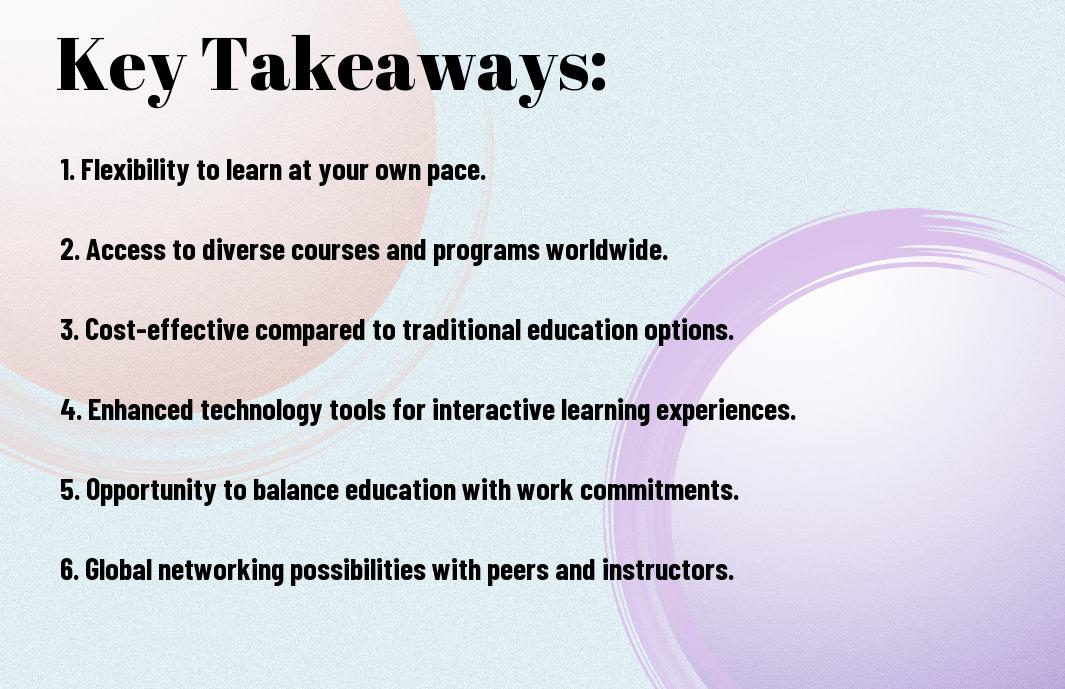
To succeed in the ever-evolving educational landscape, consider the following points about online education in 2025:

  • Flexibility is a major advantage, allowing students to balance their studies with other responsibilities and learn at their own pace.
  • Online education provides access to a wide range of courses and programs that may not be available locally, giving students more options for their educational and career goals.
  • Cost-effective online education can help reduce tuition fees and other expenses associated with traditional campus-based learning, making it a more affordable choice.
  • Personalization is another significant benefit, as online learning platforms often use technology to tailor the learning experience to individual students’ needs and preferences.
  • Career advancement opportunities are enhanced through online education, as it helps students develop skills such as time management, self-motivation, and digital literacy, which are highly valued by employers.

Benefits of Online Education

To take advantage of the numerous benefits that online education has to offer, you can explore the advantages of online learning, such as those outlined in Benefits of Online Learning: 8 Advantages of Online Degrees, to make an informed decision about your educational path.

Increased Accessibility

By leveraging online education, you can access a wide range of courses and programs from anywhere in the world, allowing you to learn at your own pace and on your own schedule, which can be particularly beneficial for those with busy lifestyles or limited mobility.

Flexibility and Autonomy

Any online course or program you choose will provide you with the flexibility to create your own study schedule, giving you more control over your learning experience and allowing you to balance your academic responsibilities with other aspects of your life.

A significant aspect of flexibility and autonomy in online education is that you can learn from anywhere, at any time, as long as you have a stable internet connection, giving you the freedom to study in a setting that is most comfortable and convenient for you, which can help you stay motivated and engaged throughout your educational journey.
Personalized Learning Experience

It allows you to learn at your own pace, with content tailored to your needs and interests. Online education provides a customized experience, enabling you to focus on areas where you need improvement.

Adaptive Technology

Around the clock, you can access advanced learning tools that adjust to your learning style, providing real-time feedback and guidance to enhance your understanding of the subject matter.

Self-Paced Progress

Among the many benefits of online education, you will appreciate the ability to set your own schedule, allowing you to balance your learning with other aspects of your life, and making progress at a pace that suits you.

Further, as you progress through your online course, you will find that self-paced learning enables you to revisit challenging topics, reinforce your understanding, and apply your knowledge in a practical way, helping you to achieve your academic and professional goals, with your unique learning needs and preferences being consistently met throughout your educational journey.

Career Advancement Opportunities

For professionals and students alike, online education offers a flexible and accessible way to upgrade your skills and knowledge, leading to better career prospects and increased earning potential.

Enhanced Skills and Knowledge

Advancing your education through online courses, you can gain specialized skills and knowledge in your chosen field, giving you a competitive edge in the job market and enabling you to take on new challenges with confidence.

Broader Career Prospects

Opportunities for career growth and development are plentiful with online education, as you can pursue courses and certifications that align with your interests and career goals, opening doors to new and exciting career paths.

Enhanced by the flexibility and accessibility of online education, you can explore various career options and transition into new roles with ease, as your newly acquired skills and knowledge make you a more attractive candidate to potential employers, allowing you to achieve your career aspirations and succeed in your chosen profession.

Cost-Effective and Environmentally Friendly

Once again, you can benefit from online education, as it offers a cost-effective and environmentally friendly way to learn, allowing you to save money and reduce your impact on the planet.

Reduced Expenses

By choosing online education, you can significantly reduce your expenses, as you won’t need to spend money on commuting, accommodation, or textbooks, making it a more affordable option for you.

Reduced Carbon Footprint

Carbon emissions from transportation and energy consumption are significantly reduced when you opt for online education, allowing you to contribute to a more sustainable future and make a positive impact on the environment.

Even more importantly, as you continue with online education, you will be able to access a wide range of digital resources, reducing the need for physical materials and further minimizing your carbon footprint, which will not only benefit you but also the environment, as you pursue your educational goals.

Improved Student Engagement

After considering various aspects of online education, you’ll find that it offers a more engaging experience. Online courses provide flexibility, allowing you to learn at your own pace, which can lead to increased participation and motivation.

Interactive Learning Platforms

Enthralling online platforms foster a more immersive learning experience, enabling you to interact with course materials in a dynamic way, which can help you stay focused and interested in the subject matter.

Collaborative Learning Environments

Students like you benefit from collaborative learning environments, where you can engage with peers and instructors, share ideas, and work together on projects, promoting a sense of community and social learning.

Also, as you participate in online discussions and group activities, you’ll develop important skills such as communication, problem-solving, and teamwork, which are valuable in both academic and professional settings, and will help you become a more confident and effective learner.

Access to Global Resources and Networking

Despite geographical constraints, online education offers you access to global resources and networking opportunities. You can explore The 10 Benefits of Online Learning – School of Education to learn more about the advantages of online learning.

International Perspectives and Connections

Across the globe, you can connect with peers and instructors from diverse backgrounds, broadening your understanding of different cultures and perspectives.

Expanded Access to Information

After enrolling in an online course, you gain access to a vast array of digital resources, including e-books, articles, and online libraries.

International students like you can access information from renowned institutions and libraries worldwide, facilitating your research and learning experience.

To wrap up

Conclusively, as you consider your educational options in 2025, you will find that online education offers numerous benefits tailored to your needs. You can access a wide range of courses, learn at your own pace, and enjoy flexibility in your schedule. Your decision to choose online education will likely enhance your career prospects and provide you with a high-quality learning experience, making it an attractive option for you to achieve your academic and professional goals.

FAQ

Q: What are the benefits of online education in terms of flexibility and accessibility?

A: Online education offers unparalleled flexibility and accessibility, allowing students to learn at their own pace and on their own schedule. With online courses, students can access course materials, attend virtual lectures, and submit assignments from anywhere with a stable internet connection. This makes online education an ideal choice for individuals with work or family commitments, or those living in remote areas with limited access to traditional educational institutions. In 2025, online education is expected to become even more sophisticated, with the use of artificial intelligence, virtual reality, and other cutting-edge technologies to enhance the learning experience.

Q: How does online education compare to traditional education in terms of cost and quality?

A: Online education is often more affordable than traditional education, as it eliminates the need for commute, accommodation, and other expenses associated with attending a physical campus. Additionally, online education can offer the same quality of education as traditional institutions, with many online courses and programs designed and taught by industry experts and renowned faculty members. In 2025, online education is expected to become even more mainstream, with many top-ranked universities and institutions offering online courses and degree programs that are equivalent in quality to their on-campus counterparts.

Q: What kind of support and resources can students expect from online education providers in 2025?

A: Online education providers in 2025 are expected to offer a wide range of support and resources to help students succeed, including online tutoring, mentoring, and career counseling. Many online education platforms will also provide students with access to virtual libraries, online communities, and other resources to facilitate learning and collaboration. Furthermore, online education providers will prioritize student engagement and feedback, using data analytics and other tools to continuously improve the learning experience and ensure that students are well-prepared for the workforce or further education. With the advancement of technology, online education providers will be able to offer more personalized and effective support to students, leading to better learning outcomes and higher student satisfaction.

How Online Education Reduces Environmental Impact

Key Takeaways:

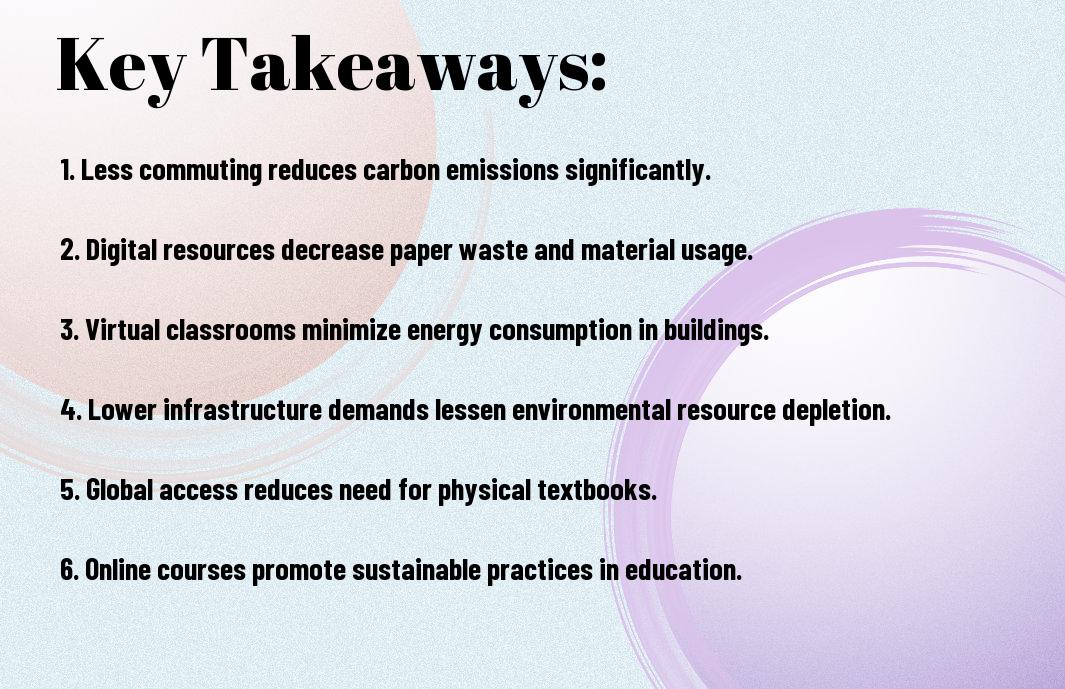
  • Online education helps in reducing the carbon footprint by minimizing the need for transportation to and from educational institutions, resulting in lower greenhouse gas emissions.
  • The shift to online learning reduces the demand for physical infrastructure, such as buildings and classrooms, which in turn reduces the need for energy consumption and water usage.
  • Online education promotes the use of digital resources, reducing the need for printed materials and minimizing waste generation.
  • By reducing the need for commuting, online education helps decrease air pollution and contributes to a cleaner and healthier environment.
  • Overall, online education offers a more sustainable approach to learning, allowing students to access quality education while minimizing their ecological impact.

Environmental Consequences of Traditional Education

The traditional education system has a significant impact on the environment, and as you investigate into the details, you’ll find that it’s affecting the planet in various ways. You can learn more about the Impact of E-learning on the environment and its benefits and how it compares to traditional methods.

Carbon Footprint of Physical Infrastructures

Between the construction of buildings, energy consumption, and transportation, traditional education institutions have a substantial carbon footprint, and as you consider the alternatives, you’ll see that online education offers a more sustainable solution.

Waste Management in Educational Institutions

An overlooked aspect of traditional education is waste management, and as you explore this topic, you’ll discover that educational institutions generate a significant amount of waste, from paper and plastic to food and electronics, which can have a lasting impact on the environment.

Indeed, as you investigate further, you’ll find that the waste generated by traditional educational institutions is not only harmful to the environment, but it also reflects a lack of consideration for the planet’s well-being, and by choosing online education, you can significantly reduce your contribution to this problem, creating a more sustainable future for yourself and future generations.

Digital Learning and Its Benefits

One of the most significant advantages of online education is the flexibility and accessibility it offers you, allowing you to learn from anywhere, at any time, and at your own pace, thus making it an attractive option for those seeking to expand their knowledge and skills.

Reduced Paper Consumption and E-Waste

Similarly, one of the key benefits of digital learning is the significant reduction in paper consumption and e-waste, which not only helps minimize your environmental footprint but also reduces the costs associated with traditional learning materials, making education more sustainable and affordable for you.

Virtual Classrooms and Energy Efficiency

Around the world, you are witnessing a shift towards virtual classrooms, which are not only more energy-efficient but also provide you with a unique opportunity to engage with a global community of learners, fostering a more collaborative and dynamic learning environment that is tailored to your needs and preferences.

Indeed, as you examine deeper into the world of virtual classrooms, you will discover that they offer a multitude of benefits, from reducing the need for physical infrastructure and energy consumption to providing you with access to a vast array of educational resources and tools, thereby enhancing your overall learning experience and empowering you to take control of your educational journey.

Online Education and Resource Conservation

Keep in mind that online education plays a significant role in reducing your environmental footprint. By transitioning to digital platforms, you contribute to a more sustainable future, conserving resources and minimizing waste.

Access to Digital Resources and Reduced Textbook Waste

About the benefits of online education, you’ll find that accessing digital resources significantly reduces textbook waste, allowing you to learn without the guilt of contributing to deforestation and pollution.

Cloud Computing and Data Storage

Any doubts you may have about the environmental impact of online education should be alleviated by the fact that cloud computing and data storage enable you to access vast amounts of information without the need for physical infrastructure, reducing your carbon footprint.

This facet of online education is particularly noteworthy, as it enables you to store and access vast amounts of data without the need for physical servers, thereby reducing energy consumption and minimizing electronic waste, allowing you to focus on your studies while contributing to a more sustainable world.

Impact on Student Transportation and Commuting

All aspects of your daily commute are significantly altered when you switch to online education, as the need to travel to a physical campus is eliminated, thereby reducing your carbon footprint.

Reduced Fuel Consumption and Air Pollution

Altogether, the decrease in fuel consumption has a profound impact on air pollution, as you are no longer contributing to the emissions from vehicles, thus creating a cleaner environment for yourself and your community.

Increased Accessibility for Remote Students

The notion that online education can reach you regardless of your geographical location is a significant advantage, as you can now access educational resources and opportunities that were previously inaccessible due to distance or mobility constraints.

Considering the vast array of online educational platforms and tools available, you can now participate in courses and degree programs that cater to your interests and career goals, without having to relocation or compromise on your personal circumstances, ultimately enhancing your overall learning experience and potential for personal growth.

Innovative Technologies for Sustainable Education

After embracing online education, you can explore various innovative technologies that promote sustainability. You will discover new ways to reduce your environmental footprint while accessing quality education.

Virtual Reality and Immersive Learning Experiences

Sensibly, you can utilize virtual reality to create immersive learning experiences that mimic real-world environments, reducing the need for physical infrastructure and travel.

Artificial Intelligence and Personalized Learning

On the path to sustainable education, you will encounter artificial intelligence as a key player in personalized learning. You can leverage AI to tailor your educational experience, making it more efficient and effective.

Understanding how artificial intelligence works in personalized learning, you can appreciate the potential to minimize waste and optimize resource allocation. As you investigate deeper, you will find that AI-driven adaptive learning systems can help you learn at your own pace, reducing the need for repeated lessons and minimizing energy consumption.

Challenges and Limitations of Online Education

For your consideration, as you probe into online education, you will encounter challenges that hinder its potential to reduce environmental impact. You can explore Practical Strategies to Reduce Environmental Impact to understand the complexities involved.

Digital Divide and Accessibility Issues

Apart from the obvious benefits, you will notice that online education also raises concerns about accessibility, as not all individuals have equal access to digital resources, thereby limiting your reach and effectiveness.

Technical Challenges and Infrastructure Limitations

Beneath the surface of online education lies a array of technical challenges, including poor internet connectivity and outdated hardware, which can hinder your ability to fully engage with online courses and materials.

Technical infrastructure plays a significant role in determining the success of online education, and as you navigate this landscape, you will need to consider factors such as bandwidth, server capacity, and software compatibility to ensure seamless delivery of educational content, thereby enhancing your overall learning experience.

To wrap up

Drawing together the threads of this discussion, you can see that online education plays a significant role in minimizing your ecological footprint. As you explore the benefits of virtual learning, you may want to explore into the Pros and cons of online education as a measure to reduce carbon emissions, and discover how your choices can contribute to a more sustainable future, shaping your approach to education and the environment.

FAQ

Q: How does online education reduce carbon footprint?

A: Online education significantly reduces carbon footprint by minimizing the need for commuting to educational institutions. With online learning, students can access courses and educational resources from anywhere, eliminating the need for transportation, which is a major contributor to greenhouse gas emissions. Additionally, online education reduces the demand for physical infrastructure, such as classrooms and buildings, which also helps to decrease carbon emissions. By reducing the carbon footprint, online education plays a significant role in mitigating climate change and promoting sustainability.

Q: What role does digitalization play in reducing waste in online education?

A: Digitalization plays a significant role in reducing waste in online education by minimizing the need for physical materials such as textbooks, paper, and other printed resources. Online educational platforms provide digital access to course materials, readings, and assignments, which reduces the amount of waste generated by traditional educational methods. Furthermore, digitalization enables the reuse and sharing of resources, reducing the demand for new materials and minimizing electronic waste. By adopting digitalization, online education contributes to a more sustainable and environmentally-friendly learning environment.

Q: How does online education promote sustainable resource utilization?

A: Online education promotes sustainable resource utilization by optimizing the use of resources such as energy, water, and land. With online learning, educational institutions can reduce their energy consumption by minimizing the need for lighting, heating, and cooling physical classrooms. Additionally, online education reduces the demand for water and land, as there is no need for physical infrastructure. Online education also promotes the use of renewable energy sources and encourages the adoption of sustainable practices, such as reducing paper usage and minimizing electronic waste. By promoting sustainable resource utilization, online education contributes to a more environmentally conscious and responsible learning environment.

The Role of AI Tutors in Online Education

As you explore online education, you’re likely to encounter AI tutors that enhance your learning experience. You’ll find that these intelligent systems provide personalized support, helping you grasp complex concepts and track your progress. With AI tutors, you can expect tailored feedback and guidance, allowing you to learn at your own pace. Your educational journey is about to become more efficient and effective, thanks to the innovative role of AI tutors in online education, which you will discover in this blog post.

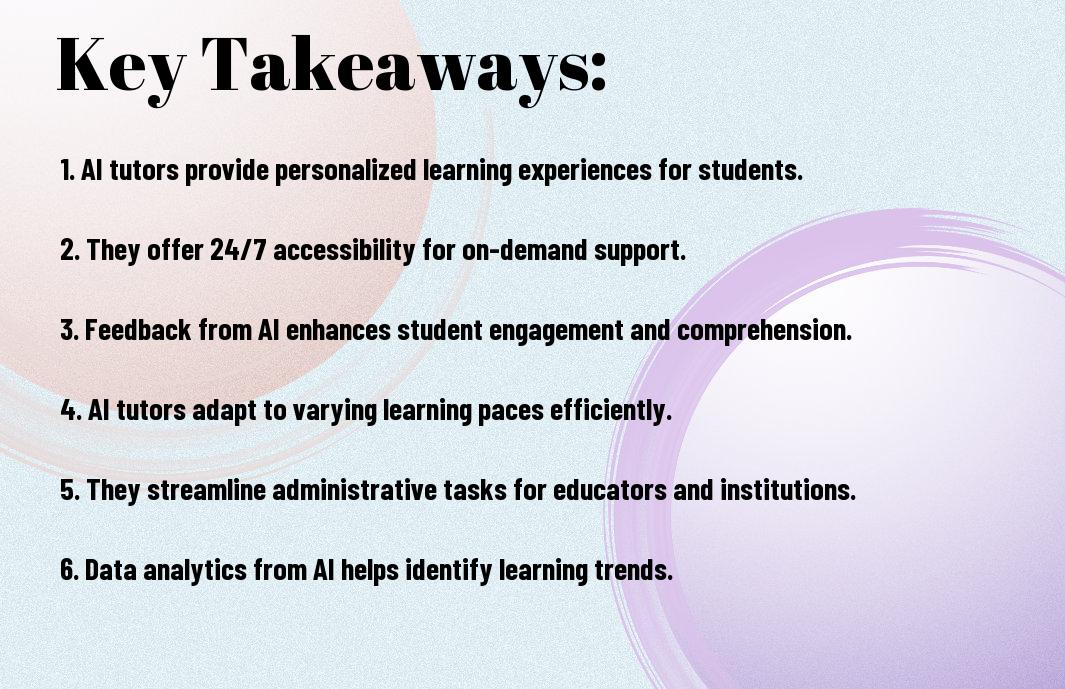
Key Takeaways:

  • The integration of Artificial Intelligence (AI) in online education has led to the development of AI Tutors, which are revolutionizing the way students learn and interact with educational content.
  • Personalized Learning is a key benefit of AI Tutors, as they can adapt to individual students’ needs, abilities, and learning styles, providing a more effective and engaging learning experience.
  • Intelligent Systems can analyze vast amounts of data to identify knowledge gaps and provide targeted feedback, enabling students to fill in the gaps and improve their understanding of complex concepts.
  • The use of Natural Language Processing (NLP) in AI Tutors enables them to understand and respond to students’ queries in a more human-like manner, making the learning experience more interactive and immersive.
  • The implementation of AI-powered Tutors can help reduce the Teacher-Student Ratio, enabling educators to focus on more complex and creative tasks, while AI Tutors handle routine and administrative duties.

Benefits of AI Tutors

The integration of AI tutors in online education offers numerous advantages, including personalized learning experiences and enhanced student engagement, allowing you to tailor your educational approach to meet your unique needs and goals.

Personalized Learning

Beneath the surface of traditional learning methods, AI tutors provide you with customized lesson plans, adapting to your learning style and pace, ensuring that you grasp concepts more effectively.

Enhanced Student Engagement

Akin to a dedicated mentor, AI tutors foster a more interactive and immersive learning environment, enabling you to stay motivated and focused on your academic objectives.

Tutors that utilize AI technology can further facilitate engagement by offering real-time feedback, allowing you to track your progress and make adjustments to your learning strategy, thereby optimizing your overall educational experience.

Limitations of AI Tutors

There’s a need to consider the limitations of AI tutors in online education, as you explore their potential benefits. You will encounter several challenges that can impact your learning experience.

Lack of Human Interaction

Around the topic of human connection, approximately all students value the personal touch that a human tutor can provide, which you may find missing in AI-powered systems.

Technical Issues

On the technical side, you may encounter difficulties such as system glitches or compatibility problems that can hinder your progress with AI tutors.

With the rapid evolution of technology, you can expect some technical issues to arise when using AI tutors, such as servers going down or algorithms malfunctioning, which can disrupt your learning flow and cause frustration, so you need to be prepared to troubleshoot or find alternative solutions to minimize downtime and stay on track with your studies.

Effective Implementation

Unlike traditional teaching methods, AI-powered education requires careful planning and execution to yield optimal results, and as you commence on this journey, you’ll find that a well-structured approach is important for reaping the benefits of AI tutors in online education.

Integrated Learning Systems

Systematically, you will need to assess your current educational infrastructure to determine the best way to incorporate AI tutors, ensuring a seamless integration that enhances your overall learning experience, and as you do so, you’ll notice significant improvements in your students’ engagement and academic performance.

Teacher Support

On the path to implementing AI tutors, you will need to consider the role of teachers in this new paradigm, and as you navigate this shift, you’ll discover that AI is not a replacement for human educators, but rather a tool to support and augment their capabilities, allowing you to focus on what matters most – providing personalized guidance and mentorship to your students.

In fact, as you explore the possibilities of AI-powered education, you’ll find that teacher support is an important component of this ecosystem, enabling you to create a more collaborative and effective learning environment, where AI tutors handle routine tasks, freeing you to concentrate on high-touch, human aspects of teaching, such as motivating and inspiring your students to reach their full potential.

Future of AI Tutors

To explore the potential of AI tutors, you can visit Are AI Tutors and Assistants the Future of Personalized Education to learn more about their impact on online education.

Advancements in AI Technology

Advancing technology is continuously improving AI tutors, enabling them to provide more effective and personalized learning experiences for you, helping your understanding of complex concepts.

Expanding Accessibility

Any barriers to education can be addressed with AI tutors, which offer flexible and accessible learning solutions, allowing you to learn at your own pace.

And as you consider the role of AI tutors in expanding accessibility, you’ll find that they can reach a wider audience, including those with disabilities or remote locations, providing equal opportunities for education and helping you achieve your learning goals.

Challenges and Concerns

For educators and students alike, the integration of AI tutors in online education raises several concerns that you should be aware of, as you consider implementing these tools in your learning environment.

Job Displacement

To address the potential impact on your career, you should consider that AI tutors may automate certain tasks, which could lead to job displacement for some educators, as you navigate the changing landscape of online education.

Data Privacy

About the safety of your personal information, you may wonder how AI tutors collect and use your data, and whether your privacy is protected, as you interact with these systems.

But as you investigate deeper into the issue of data privacy, you will find that many AI-powered tutoring platforms have robust security measures in place to safeguard your information, and you can take steps to protect your data by carefully reviewing the terms and conditions of these platforms, and being mindful of the information you share with them.

Best Practices

Now that you’re considering implementing AI tutors in your online education platform, it’s crucial to establish effective guidelines. You’ll need to ensure that these AI systems are used in a way that complements your teaching methods and enhances your students’ learning experience.

Blended Learning Models

With the rise of AI-powered education tools, you can create a hybrid learning environment that combines traditional teaching methods with AI-driven instruction. You can use AI tutors to provide personalized support to your students, freeing up your time to focus on more complex tasks.

Continuous Evaluation

Any successful implementation of AI tutors relies on your ability to monitor and assess their effectiveness. You need to regularly evaluate the performance of these systems, identifying areas where they can be improved to better support your students’ learning needs.

Due to the rapid evolution of AI technology, you must stay up-to-date with the latest developments in continuous evaluation methods. You can use data analytics tools to track your students’ progress, assess the AI tutor’s performance, and make data-driven decisions to optimize your online education platform. By doing so, you can ensure that your AI tutors are providing the best possible support for your students, and that your online education platform remains effective and competitive.

Final Words

The implementation of AI tutors in online education is transforming your learning experience. As you explore this emerging field, you can learn more about What Happens When an AI Assistant Helps the Tutor, Instead of the Student. Your understanding of AI’s role will help you navigate the future of online education, enabling you to make informed decisions about your own learning journey.

FAQ

Q: What is the primary function of AI tutors in online education?

A: The primary function of AI tutors in online education is to provide personalized support and guidance to students as they navigate through their coursework. AI tutors use machine learning algorithms to assess a student’s strengths, weaknesses, and learning style, and then tailor their instruction to meet the individual needs of each student. This can include providing real-time feedback, offering additional practice problems or review materials, and even helping students to stay organized and on track with their assignments.

Q: How do AI tutors enhance the learning experience for students in online education?

A: AI tutors enhance the learning experience for students in online education by providing a more engaging, interactive, and effective learning environment. AI-powered adaptive learning systems can adjust the difficulty level of course materials in real-time, ensuring that students are consistently challenged but not overwhelmed. Additionally, AI tutors can facilitate more efficient communication between students and instructors, enabling students to ask questions and receive support at any time. This can be especially beneficial for students who may be hesitant to ask questions in a traditional classroom setting or who require extra support outside of regular office hours.

Q: Can AI tutors replace human instructors in online education, or do they serve a complementary role?

A: AI tutors are not intended to replace human instructors in online education, but rather to serve a complementary role. While AI can provide personalized support and instruction, human instructors bring a level of emotional intelligence, empathy, and nuance to the learning experience that is difficult to replicate with technology alone. AI tutors can help to supplement the instruction provided by human teachers, freeing them up to focus on more complex and high-value tasks such as facilitating discussions, providing feedback on assignments, and mentoring students. By working together, human instructors and AI tutors can create a more comprehensive and effective learning experience that leverages the strengths of both humans and machines.

The Impact of Mobile Technology on Online Education

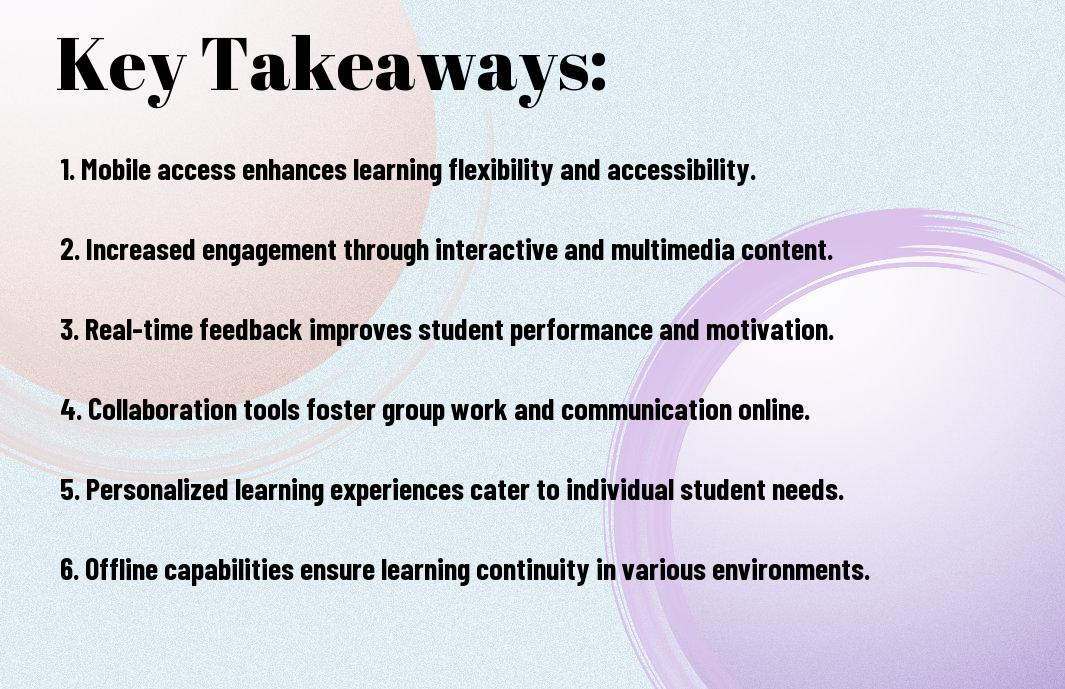
Key Takeaways:

  • The accessibility of online educational resources has increased significantly with the advent of mobile technology, allowing students to access course materials and participate in learning activities from anywhere, at any time.
  • Personalized learning experiences can be created using mobile devices, enabling students to learn at their own pace and receive tailored feedback and assessments.
  • The use of mobile apps and learning management systems can enhance student engagement and motivation, as well as provide instructors with valuable insights into student performance and progress.
  • Mobile technology has also enabled the development of virtual classrooms and online communities, facilitating collaboration and interaction among students and instructors across geographical locations.
  • The affordability and convenience of mobile devices have made online education more inclusive, allowing students from diverse backgrounds and locations to access high-quality educational resources and opportunities.

Mobile Technology in Education

A significant shift is occurring in the way you learn, as mobile technology becomes increasingly integrated into educational settings, offering you new opportunities for flexible and accessible learning.

Advantages of Mobile Learning

Albeit with some limitations, mobile learning provides you with the ability to access a wide range of educational resources, facilitating a more personalized and engaging learning experience, as you can learn at your own pace, anytime and anywhere.

Challenges of Mobile Integration

Toward the successful implementation of mobile technology in education, you will encounter several obstacles, including issues related to equity, connectivity, and distraction, which can hinder the effectiveness of mobile learning, as you navigate the complexities of this new educational landscape.

Consequently, as you explore deeper into the challenges of mobile integration, you will find that addressing these issues requires a thoughtful and multi-faceted approach, taking into account your individual needs, the infrastructure of your educational institution, and the pedagogical goals of your courses, in order to unlock the full potential of mobile technology and enhance your overall learning experience.

Online Education Platforms

You are likely familiar with the numerous online education platforms that have emerged in recent years, offering a wide range of courses and degree programs. These platforms have made it possible for you to access educational content from anywhere, at any time.

Evolution of Online Learning

For instance, the development of online learning platforms has undergone significant changes, shifting from traditional classroom-based learning to more flexible and accessible formats. This evolution has enabled you to take control of your learning experience.

Role of Mobile Devices in Online Education

Beneath the surface of online education lies the significant impact of mobile devices, which have enabled you to access educational content on-the-go. Your mobile device has become an imperative tool for learning, allowing you to participate in online discussions and access course materials.

Online learning has become more personalized and interactive, thanks to the role of mobile devices in online education. As you navigate through online courses, you can access multimedia content, participate in discussions, and engage with instructors and peers, all from the convenience of your mobile device, thereby enhancing your overall learning experience.

Student Engagement and Motivation

Not surprisingly, mobile technology has transformed the way you approach online education, and as you can explore The Growth of Mobile Technologies in Educational Settings, you’ll find that it has a significant impact on your learning experience.

Impact of Mobile Technology on Student Participation

Mobility has become a key factor in enhancing your participation in online courses, as you can access course materials and engage with your peers from anywhere, at any time.

Mobile Devices as Motivational Tools

Mobility enables you to use your mobile devices as motivational tools, providing you with a sense of freedom and flexibility that can boost your enthusiasm for learning.

Participation in online discussions and activities becomes more engaging when you use mobile devices, as you can share your thoughts and ideas instantly, and you’ll find that your motivation to learn increases as you feel more connected to your course materials and peers.

Accessibility and Equity

All aspects of online education are influenced by mobile technology, and you will find that it has a significant impact on accessibility and equity, enabling you to access educational resources from anywhere, at any time, as long as you have a mobile device and internet connection.

Mobile Technology and Accessibility in Education

Beneath the surface of this conveniece lies a complex issue, as you consider how mobile technology affects the way you learn, and you will notice that it opens up new opportunities for students with disabilities, allowing you to participate more easily in online courses.

Addressing the Digital Divide

Prior to the widespread adoption of mobile technology, you may have faced significant barriers to accessing online education, but now you can use mobile devices to access educational resources, helping to bridge the gap between those who have access to technology and those who do not.

Consequently, as you research deeper into the world of online education, you will see that mobile technology has the potential to increase equity in education, but you must also consider the challenges that still exist, such as the cost of mobile devices and internet access, and how these challenges affect your ability to participate in online learning.

Pedagogical Implications

To effectively integrate mobile technology into online education, you should consider its impact on your teaching methods. As you explore the possibilities of mobile learning, you can learn more about The Role of Mobile Technology in Improving Accessibility and Quality of Learning to enhance your understanding.

Teaching Methods in the Mobile Era

Toward a more mobile-centric approach, you will need to adapt your teaching strategies to accommodate the unique characteristics of mobile devices, allowing you to create more engaging and interactive learning experiences for your students.

Redefining Teacher Roles

Methods of instruction are evolving, and as you navigate this shift, you will find that your role as an educator is transforming to accommodate the needs of mobile learners, requiring you to be more flexible and responsive to the changing needs of your students.

With the integration of mobile technology, you will have the opportunity to reimagine your role as a teacher, focusing on facilitating collaborative learning, providing personalized support, and developing interactive content that caters to the diverse needs of your students, ultimately enhancing the overall learning experience and helping you to create a more dynamic and effective online learning environment.

Future Directions

Many developments in mobile technology will continue to shape the online education landscape, offering you new opportunities for learning and growth, as you navigate the ever-changing world of digital education.

Emerging Trends in Mobile Education

Alongside the rise of mobile devices, you will see a shift towards more personalized and interactive learning experiences, allowing you to take greater control of your educational journey, with mobile education trends evolving to meet your unique needs.

Harnessing Mobile Technology for Educational Innovation

Aware of the potential benefits, you can leverage mobile technology to enhance your learning experience, as educators and institutions work to harness its power, creating innovative solutions to meet the demands of modern learners like you.

Mobile technology will undoubtedly play a significant role in shaping your educational experience, as you consider how to effectively integrate it into your learning routine, you will need to think critically about the ways in which it can support your academic goals, and how you can use it to access a wide range of educational resources, from online courses to interactive simulations, and collaborative learning tools, thereby expanding your opportunities for growth and development.

Conclusion

Drawing together the various threads of discussion, you can see that mobile technology has transformed your online education experience. As you explore the possibilities, consider consulting resources like (PDF) The effects of the use of mobile devices on the E-learning process to deepen your understanding of this impact, and shape your approach to your own learning in a rapidly changing world.

FAQ

Q: What are the benefits of mobile technology in online education?

A: The integration of mobile technology in online education has numerous benefits, including increased accessibility, flexibility, and convenience. With mobile devices, students can access course materials, participate in discussions, and submit assignments from anywhere, at any time. This flexibility is particularly beneficial for students with busy schedules or those who live in remote areas with limited access to traditional educational institutions. Moreover, mobile technology enables educators to create interactive and engaging learning experiences, such as gamification, simulations, and virtual labs, which can enhance student engagement and motivation.

Q: How does mobile technology enhance the learning experience in online education?

A: Mobile technology enhances the learning experience in online education by providing a personalized and interactive learning environment. Mobile devices allow students to access a wide range of educational resources, including videos, podcasts, and educational apps, which can be tailored to their individual learning needs and preferences. Additionally, mobile technology enables real-time feedback and assessment, which can help students track their progress and identify areas where they need improvement. Furthermore, mobile devices facilitate collaboration and communication among students and instructors, which can foster a sense of community and support in online learning environments.

Q: What are the potential challenges and limitations of using mobile technology in online education?

A: Despite the benefits of mobile technology in online education, there are several potential challenges and limitations that need to be considered. One of the main challenges is the issue of equity and access, as not all students may have access to mobile devices or reliable internet connectivity. Another challenge is the potential for distractions and multitasking, which can negatively impact student engagement and learning outcomes. Furthermore, mobile technology can also create new opportunities for academic dishonesty and cheating, which can compromise the integrity of online education. Finally, instructors may need to invest time and effort into developing mobile-friendly course materials and learning activities, which can be a significant challenge, particularly for those with limited technical expertise.

How Online Education Shapes the Future Workforce

As you consider the evolving landscape of learning, you may wonder how online education is redefining your professional prospects. You are likely aware that the way you acquire skills and knowledge today will significantly impact your career tomorrow. Your ability to adapt to this shift will be necessary in navigating the future workforce, where technological advancements and digital literacy are increasingly valued. You will need to understand the implications of online education on your future career.

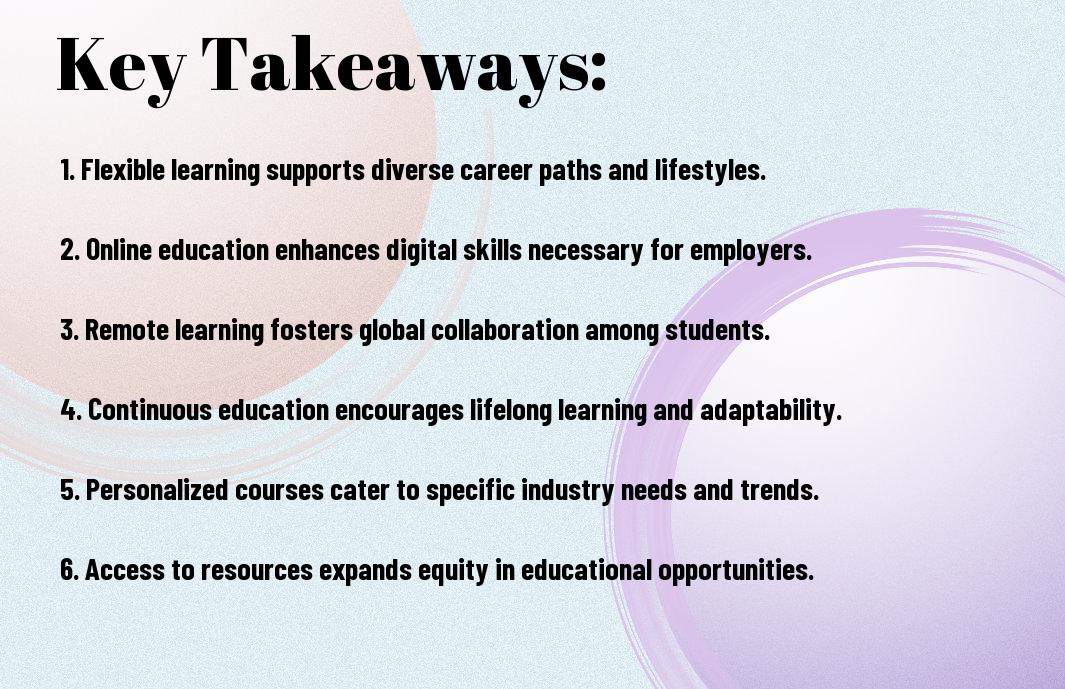
Key Takeaways:

  • The digitalization of education is transforming the way we learn and acquire skills, preparing the future workforce for an increasingly tech-driven economy.
  • Online learning platforms are making education more accessible and affordable, allowing people to acquire new skills and knowledge from anywhere in the world.
  • The flexibility of online education enables students to balance work and learning, making it an attractive option for those who need to upskill or reskill to remain competitive in the job market.
  • Artificial intelligence and data analytics are being used to create personalized learning experiences, helping students develop the skills and competencies required by the future workforce.
  • The shift to online education is driving a paradigm shift in the way we think about work and learning, with a focus on lifelong learning and continuous skill development to stay relevant in a rapidly changing job market.

The Rise of Online Education

The advent of online education has transformed the way you learn, offering a plethora of opportunities for skill development and knowledge acquisition. As you navigate this digital landscape, you’ll find that online courses and degree programs are becoming increasingly popular, catering to diverse learning styles and preferences.

Changing Learning Environments

Following the shift towards online learning, you’ll notice that traditional classroom settings are giving way to virtual environments, allowing you to learn at your own pace and convenience. As you adapt to these new environments, you’ll discover that they provide a more personalized and interactive learning experience.

Accessibility and Flexibility

With the rise of online education, you’ll find that accessing educational resources has become easier, enabling you to balance your learning with other aspects of your life. You can now learn from anywhere, at any time, as long as you have a stable internet connection.

It is worth noting that this increased accessibility and flexibility have significant implications for your future career prospects, as you’ll be able to acquire new skills and knowledge that are relevant to the modern workforce, making you a more competitive candidate in the job market.

Skills for the Digital Age

There’s a shift in the skills you need to succeed in the digital age, and online education is leading the way. You can learn more about The Role Of Online Learning In The Future Of Work and how it’s changing the workforce.

Critical Thinking and Problem-Solving

Around the concept of critical thinking, you’ll find that online education helps you develop skills to analyze information and make informed decisions, preparing you for the future workforce.

Collaboration and Communication

The ability to work with others and communicate effectively is vital in the digital age, and online education provides you with opportunities to develop these skills through virtual team projects and discussions.

But as you probe deeper into the concept of collaboration and communication, you’ll find that online education offers you a unique chance to work with people from diverse backgrounds and industries, helping you to develop a global perspective and prepares you to navigate the complexities of the modern workforce, allowing you to thrive in a world where technology is constantly evolving, and you must be able to adapt and innovate to stay ahead.

The Impact on Traditional Education

Once again, you find yourself at the forefront of a revolution, as online education transforms the way you learn and interact with educational institutions. Your traditional classroom experience is evolving, and you must adapt to the changing landscape.

Shifts in Teaching Methods

Along with the rise of online education, you notice a significant change in the way teachers approach their craft. Your instructors are now more focused on facilitating online discussions and creating interactive content, making your learning experience more engaging and personalized.

New Roles for Educators

By embracing technology, you begin to see educators taking on new roles, such as content curators and learning coaches, helping you navigate the vast amounts of information available online. Your teachers are now more focused on guiding you towards the most relevant and accurate sources.

Impact of these new roles on your education is profound, as you start to take more ownership of your learning process. You begin to appreciate the value of self-directed learning, and your educators are there to support and mentor you, rather than simply lecturing. As you progress, you will find that your ability to learn and adapt will be more valuable than ever, and your educators will be there to help you develop these skills.

Preparing Students for the Future

Despite the challenges, online education plays a significant role in shaping the future workforce by providing you with the skills and knowledge required to succeed in an ever-changing job market.

Career Readiness and Employability

Alongside traditional subjects, online education offers you courses that focus on developing your soft skills, making you more attractive to potential employers and better prepared for the workforce.

Lifelong Learning and Adaptation

Likewise, online education fosters a mindset of continuous learning, allowing you to stay up-to-date with the latest developments in your field and adapt to new technologies and methodologies.

Even as you graduate and enter the workforce, you will find that online education has prepared you to be flexible and responsive to the evolving needs of your profession, enabling you to pursue ongoing learning and professional development opportunities that will enhance your career prospects and keep your skills relevant in a rapidly changing world, and you will be able to navigate the complexities of your chosen field with confidence and expertise.

Challenges and Limitations

Keep in mind that online education is not without its challenges, and as you consider its impact on the future workforce, you must acknowledge the limitations that come with it.

Equity and Access to Technology

One of the primary concerns is that not all individuals have equal access to the technology needed for online education, and as you think about the implications, you should consider how this affects your own understanding of the issue.

Social Isolation and Motivation

Motivated students may thrive in online environments, but as you ponder the effects of social isolation, you should think about how it might influence your own ability to stay engaged and motivated in a virtual setting.

But as you investigate deeper into the issue of social isolation and motivation, you will find that it is a complex problem, and you must consider how the lack of face-to-face interaction can affect your emotional and psychological well-being, ultimately impacting your overall learning experience and preparation for the future workforce.

Innovative Solutions and Technologies

All the advancements in online education are driven by innovative solutions and technologies, and as you explore this landscape, you can learn more about Shaping the Future of Online Learning to understand the evolving needs of the workforce.

Artificial Intelligence and Personalization

At the forefront of online education, you will find artificial intelligence and personalization, which are being used to create customized learning experiences tailored to your needs and learning style, enabling more effective knowledge acquisition.

Virtual and Augmented Reality

Among the most significant technological advancements in online education, virtual and augmented reality are changing the way you interact with educational content, making it more immersive and engaging, and you can expect to see more of these technologies in the future.

Hence, as you examine deeper into virtual and augmented reality, you will discover new possibilities for experiential learning, where you can practice and apply your skills in simulated environments, preparing you for the complexities of the real world, and enabling you to develop a more nuanced understanding of the subjects you study, which will ultimately shape your future in the workforce.

Summing up

Following this exploration of online education, you begin to see how it reshapes your understanding of the future workforce. As you consider the implications, you realize that your skills and knowledge will be constantly evolving. Your ability to adapt to new technologies and learning platforms will be vital in this new landscape, and you must be prepared to navigate the changing demands of the job market, ultimately transforming your role in the workforce.

FAQ

Q: How is online education changing the skills required for the future workforce?

A: Online education is revolutionizing the skills required for the future workforce by shifting the focus from traditional classroom learning to a more flexible and technology-driven approach. With the rise of online learning, students can now access a wide range of courses and training programs that equip them with the skills needed to succeed in an increasingly digital and interconnected world. These skills include digital literacy, data analysis, problem-solving, and collaboration, which are vital for professionals to stay competitive in the job market.

Q: What role does online education play in preparing students for the gig economy and remote work?

A: Online education plays a significant role in preparing students for the gig economy and remote work by providing them with the skills and knowledge needed to thrive in a flexible and ever-changing work environment. Online courses and training programs can help students develop the skills required for freelance work, such as self-motivation, time management, and communication, as well as the technical skills needed for remote work, such as video conferencing and digital project management. Additionally, online education can help students develop a mindset that is adaptable to change and open to continuous learning, which is vital for success in the gig economy.

Q: How does online education impact the accessibility and diversity of the future workforce?

A: Online education has a profound impact on the accessibility and diversity of the future workforce by breaking down geographical and socio-economic barriers to education and career advancement. With online learning, students from all over the world can access high-quality educational resources and training programs, regardless of their location or financial means. This has led to a more diverse and inclusive workforce, where individuals from underrepresented groups can now participate and contribute their unique perspectives and skills. Furthermore, online education can also help address issues of inequality and social mobility by providing opportunities for people with disabilities, caregivers, and those in remote or underserved communities to access education and job opportunities that may have been inaccessible to them otherwise.

Skip to content