Key Takeaways:
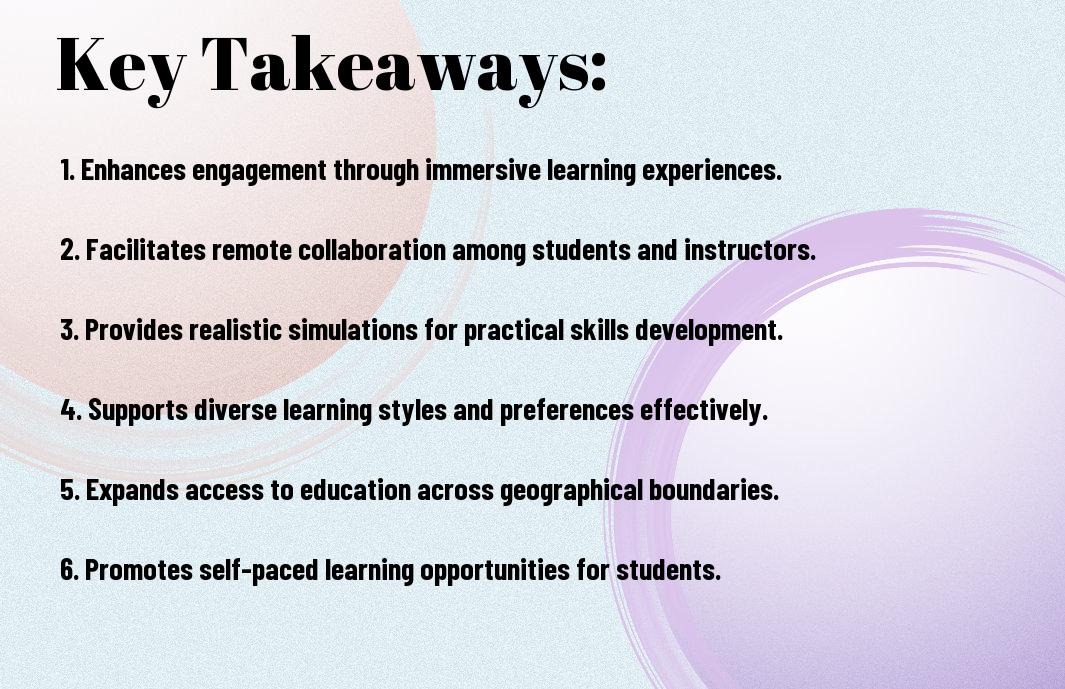
- The use of Virtual Reality in online education can greatly enhance the learning experience by providing an immersive and interactive environment for students to engage with the course material.
- Personalized learning is another significant benefit of incorporating Virtual Reality into online education, as it allows students to learn at their own pace and focus on areas where they need improvement.
- The implementation of Virtual Reality in online education can also increase student engagement and motivation, as it provides a more enjoyable and dynamic way of learning compared to traditional methods.
- Cost-effective solutions can be achieved through the use of Virtual Reality in online education, as it eliminates the need for physical infrastructure and transportation, making it more accessible to a wider range of students.
- The integration of Virtual Reality in online education can also provide real-time feedback and assessment, enabling instructors to track student progress and adjust their teaching methods accordingly to improve learning outcomes.
The Potential of Virtual Reality
While virtual reality (VR) is still a developing technology, you can expect it to play a significant role in shaping the future of online education. As you explore the potential of VR, you’ll discover its ability to create immersive and interactive learning experiences.
Enhancing Student Engagement
Around the concept of student engagement, you’ll find that VR has the potential to increase participation and motivation in your online courses. By providing an immersive experience, you can capture your students’ attention and encourage them to take a more active role in their learning.
Improving Learning Outcomes
Outcome-based research suggests that VR can have a positive impact on your students’ learning outcomes. As you incorporate VR into your teaching methods, you can expect to see improvements in knowledge retention and understanding of complex concepts.
With the ability to simulate real-world environments and scenarios, you can create personalized learning experiences that cater to your students’ individual needs. As you utilize VR in your online education, you’ll be able to track your students’ progress and adjust your teaching strategies to optimize their learning outcomes, allowing you to make data-driven decisions to improve your educational content and delivery.
Technical Requirements
Some technical specifications are necessary for a seamless virtual reality experience in online education. You can explore more about this topic in a publication on Web and virtual reality as platforms to improve online education experiences.
Hardware and Software Needs
One of the primary considerations for virtual reality in online education is the hardware and software you will need. You will require a compatible device, headset, and controllers to facilitate an immersive experience.
Accessibility and Affordability
Before implementing virtual reality in your online education, consider the accessibility and affordability of the technology for your students. You need to ensure that your students have access to the necessary hardware and software.
And as you investigate deeper into the aspects of accessibility and affordability, you will find that there are various options available to make virtual reality more inclusive, such as affordable headsets and free software, allowing you to provide your students with an immersive learning experience without breaking the bank.
Pedagogical Applications
Now, as you explore the role of virtual reality in online education, you’ll discover its numerous pedagogical applications, transforming the way you learn and interact with educational content.
Simulations and Interactive Models
Bridging the gap between theory and practice, you can use virtual reality to create immersive simulations and interactive models that enhance your understanding of complex concepts and systems.
Virtual Field Trips and Explorations
Similarly, you can use virtual reality to commence on virtual field trips and explorations, allowing you to visit and interact with remote or inaccessible locations in a highly immersive and engaging way.
In fact, as you probe deeper into virtual field trips and explorations, you’ll find that they offer a wide range of benefits, including increased accessibility, cost-effectiveness, and flexibility, enabling you to explore and learn about different environments and phenomena in a highly interactive and immersive manner, which can be tailored to your individual needs and learning style.
Challenges and Limitations
All online educational institutions face challenges when implementing virtual reality. You will encounter technical and equity issues that can hinder your progress.
Technical Issues and Glitches
By leveraging virtual reality, you may experience glitches and technical issues that can disrupt your learning experience, causing frustration and affecting your engagement.
Equity and Inclusion Concerns
The accessibility of virtual reality technology can be a concern, as you may not have equal access to the necessary equipment, which can create a divide among students.
Further, as you consider virtual reality in online education, you should think about how to address equity and inclusion concerns, ensuring that all students have the opportunity to benefit from this technology, regardless of their background or socioeconomic status, and that your educational institution provides the necessary support and resources to bridge any gaps.
Teacher Training and Support
For educators to effectively integrate virtual reality into their online education, they need proper training and support. You will need to learn how to use the technology and incorporate it into your curriculum. This will enable you to provide high-quality education to your students.
Professional Development Opportunities
Beneath the surface of successful virtual reality integration lies a need for ongoing professional development. You can take advantage of workshops, conferences, and online courses to enhance your skills and knowledge in using virtual reality technology.
Best Practices for Implementation
Alongside the development of your skills, you should consider best practices for implementing virtual reality in your online education. You will want to ensure that you are using the technology in a way that is engaging and effective for your students.
Consequently, as you probe deeper into the implementation of virtual reality, you will discover the importance of setting clear learning objectives and outcomes. You should also consider the technical requirements and ensure that your students have access to the necessary equipment and support. By doing so, you will be able to create an immersive and interactive learning experience that enhances your students’ understanding and retention of the material.
Future Directions
Keep in mind that virtual reality in online education will continue to evolve, offering new opportunities for engagement and learning.
Emerging Trends and Innovations
Trending technologies like augmented reality and mixed reality will further enhance your online learning experience, providing more interactive and immersive environments.
Potential for Personalized Learning
With the help of virtual reality, you can expect more tailored learning experiences, addressing your individual needs and learning styles, making education more effective.
Considering your unique learning preferences, virtual reality can help create personalized learning paths, allowing you to focus on areas that interest you the most, and thereby increasing your overall learning outcomes and satisfaction with the educational process.
Final Words
Presently, you can see the significant impact of virtual reality on online education, enhancing your learning experience. As you explore this technology, you will find that it offers personalized and immersive lessons, increasing your engagement and knowledge retention. You can expect virtual reality to continue shaping your educational journey, making it more interactive and effective, and you will be able to access a wide range of courses and resources in a more engaging way.
FAQ
Q: What is the role of Virtual Reality in Online Education?
A: Virtual Reality (VR) plays a significant role in online education by providing immersive and interactive learning experiences for students. VR technology enables students to engage with complex concepts and simulations in a highly realistic and engaging manner, which can enhance their understanding and retention of the subject matter. By leveraging VR, online educators can create interactive 3D models, virtual labs, and simulated environments that allow students to explore and learn in a more experiential way, making online education more effective and enjoyable.
Q: How can Virtual Reality enhance the learning experience in online education?
A: Virtual Reality can enhance the learning experience in online education in several ways. Firstly, it provides a highly interactive and immersive environment that can increase student engagement and motivation. Secondly, VR allows students to visualize complex concepts and processes in 3D, making it easier for them to understand and analyze the subject matter. Additionally, VR enables students to participate in simulated experiments and activities that would be difficult or impossible to conduct in a traditional online learning setting, providing a more hands-on and experiential learning experience. Overall, VR has the potential to make online education more engaging, effective, and enjoyable for students.
Q: What are the potential benefits and challenges of implementing Virtual Reality in online education?
A: The potential benefits of implementing Virtual Reality in online education include increased student engagement and motivation, improved learning outcomes, and enhanced student satisfaction. Additionally, VR can provide equal access to educational opportunities for students with disabilities and those located in remote areas. However, there are also challenges to implementing VR in online education, such as the high cost of VR equipment and software, the need for specialized technical support, and the potential for technical issues and glitches. Furthermore, educators may need to develop new skills and pedagogies to effectively integrate VR into their online courses, which can be a time-consuming and resource-intensive process. Despite these challenges, the potential benefits of VR in online education make it an exciting and promising area of innovation and development.